See Me. Say My Name.
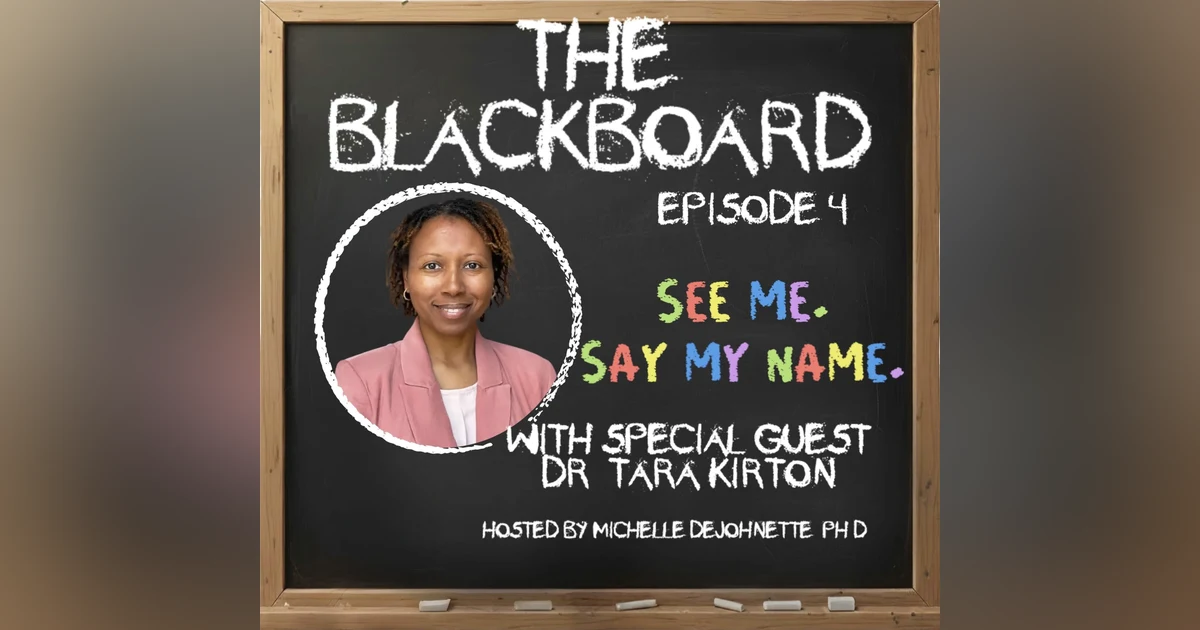


Episode Summary
What can we learn when we stop speaking about Black children and start listening to them?
In this episode, I talk with Dr. Tara Kirton about her research exploring how Black children and their families experience early childhood education. Instead of relying only on adults' perspectives, Dr. Kirton invited young children to share their own stories about school, their teachers, and what helps them feel safe, valued, and excited to learn.
We discuss why relationships matter, how something as simple as saying a child's name correctly can shape their sense of belonging, and what educators can do to create classrooms where every child feels seen and affirmed. Together, we also examine how racism, adultification, and teacher preparation influence children's everyday experiences in school.
This conversation is a reminder that children have important stories to tell—and that listening to them can change how we think about teaching, learning, and justice in early childhood education.
About the guest
Dr. Kirton holds an EdD in Curriculum and Teaching with a specialization in Early Childhood Education from Teachers College, Columbia University. She has held various positions in early childhood education over the past twenty years, some of which include preschool teacher, special education itinerant teacher (SEIT), curriculum writer, professional development facilitator, and consultant. As a SEIT Dr. Kirtonpartnered with families to advocate for young children with dis/abilities to have access to joyful learning experiences every day and to be fully integrated into their classroom environment.
About the host
Dr. Michelle DeJohnette is an Assistant Professor of Early Childhood Studies. Her work focuses on preparing early childhood educators to teach critically and responsibly through anti-racist and social justice frameworks. Drawing on critical theories and culturally responsible pedagogy, her research interrogates how systems of discipline, punishment, and surveillance reproduce inequities and anti-Blackness in Black children’s early learning experiences.
Across her teaching, research, and public scholarship, Dr. DeJohnette is committed to building inclusive, liberatory learning spaces where all children and families are seen, valued, and supported.
Credits
- Cover art by: Emporium Designs; Podcast Branding
- Outro Music: "Lift Every Voice and Sing" Thomasina Petrus & Kashimana Ahua
Stay connected
- Follow on Instagram: @theblackboardpodcast
- Subscribe to The Blackboard Podcast
- Share this episode with an educator, parent, or colleague
Dr. Kirton
I thought, who better to speak on these experiences than these young children, these beautiful kiddos who may not have that question posed to them.
Dr. Kirton
Welcome to the Blackboard podcast. I'm Dr. Michelle DeJonette, educator, researcher, and advocate for racial justice in early childhood education.This podcast examines how racialized and gendered inequities shape Black children's early learning experiences.Through conversations with scholars, educators, and families, we make research accessible, actionable, and rooted in real life because Black childhood deserves protection, joy, and justice. Welcome to the Blackboard Podcast. Today's guest is the wonderful Dr. Kiton. I'm excited to talk about her dissertation.In their own words, black children and families share their experience in early childhood programs. So let's get into it. Welcome, Dr. Kirton.
Dr. Kirton
Thank you so much. I'm so excited to be here.
Dr. Kirton
Thank you so much for joining us. Before we jump into the research, I'd like to start with you. Please tell our audience about yourself.
Dr. Kirton
Sure. So I am a former preschool teacher. I worked in classrooms for a few years, and then I moved into special education itinerant work.So my background is very heavy in preschool teaching and special education. And right now I am a lecturer and researcher at Hunter College within the City University of New York.And I'm also our clinical experiences coordinator.I'm in the early childhood general education program, and I teach courses in our undergrad and graduate program as well as really just keep a close eye on where our students are being placed for fieldwork experiences and any sort of student teaching experiences. So hopefully make sure they have a successful and wonderful learning experience.
Dr. Kirton
Such important work. So you've experienced early childhood education as a parent, a teacher, and a researcher. So what led you to this study and why.Why was it important for you to center black children's voices?
Dr. Kirton
So at a very early point in my doctoral program, I started learning more about suspensions and expulsions in early childhood. And that was something that captured my attention quite a bit. And I was doing a lot of research on it. I was thinking about it from a policy level.I was taking policy courses at Teachers College to learn more. I and just really trying to figure out, like, how does this look across the country? What are different states doing to combat this?Why aren't we talking about this as child abuse as far as I'm concerned, which it is. And I was getting really down in the weeds with it, and it felt very depressing. It was really just depressing work and just very, very heavy.And while I realized that it's important and it's a conversation that I still continue to talk about, and I'll present on it and I've written about it. I also wondered about the other side of it.I wondered, like, you know, in a, in early childhood programs, if these are programs where it's the first time, in many cases, outside of like religious institutions or things of that nature, where a child is separated from their family for a period of time. And even within like religious institutions, at church you may have Sunday school or something like that, but that's for a certain amount of time.But when I was thinking about early childhood classrooms and early care, I'm thinking children might be away from their families for five, six or more hours, depending on what the setup is like and the needs of the family.And I was thinking, if that is the situation, if that's the case for many, many families across the country, what are some of the other stories that exist? And I was very curious about hearing from the perspectives of both the caregivers, the parents. But I really also wanted to hear from the children.And I think it's that background as a preschool teacher and as a parent. I just think kids often have the most interesting things to say and they will tell you like it is. And so I really wanted to hear from them.I thought, who better to speak on these experiences than these young children, these beautiful kiddos who may not have the. That question posed to them, like, what is it that about school that you like? What is it that you maybe is not your favorite?So I really started to think about just the different structures that are included. There's daycares, there's early childhood programs that are community based.There are the early childhood programs that are connected to Pre K through 12 experiences if they're in like an elementary school or something like that for Pre K through 5. And then new York City is also doing all these expansions.We have 3k for programs for 3 year olds, and now we're moving into the program for two year olds. So I really wanted to know what does that look like across New York City in different boroughs, depending on different socioeconomic statuses?I was also curious about different types of settings. Right. So I wondered, what does it look like to be in perhaps a charter school for a second grader in one borough or.Or what it might look like to be in a public school in the same borough, but in a public school for a family who has like a different socioeconomic status and lives in a different part of the borough? So I was really thinking about it broadly and wanting to get as many perspectives from the children and as well from their parents.
Dr. Kirton
As you know, I wrote my dissertation on black preschoolers, also from the preschool teachers perspectives. I interviewed preschool teachers about their beliefs about discipline.So we had the same goal in mind in terms of writing about the suspension and expulsion of these young children.And that's what drew me to your work, because it was always a thought in my mind that it would be so great to hear from the young children's perspectives. And so that's why I'm really one of the reasons why I'm really excited to have this conversation. So your dissertation is called In Their Own Words.So what did you learn when you stopped asking adults to explain children's experiences and started listening directly to black children?
Dr. Kirton
Such a good question.So what I learned from the black children were a lot of things around relationships, like things that I will say I may not have thought about as much before.One of those examples is more than once when I was interviewing the children, I heard about a teacher who was loved or like a beloved teacher who was in the school with them and who left in the middle of the school year or who left unexpectedly. And that was something that came up at least two or three times when I was talking to children. And I remember one child in particular.The way he described this teacher was he was a cool guy. You know, he was a really nice, cool guy. And it was his gym teacher.And he was explaining how this gym teacher kept them safe and how he created fun games for them to play during gym and things as simple as putting cones out to kind of have, like, guardrails around where the children could use space or how they could use it. And then also thinking about how that time of the day could be fun and collaborative.Now, when that teacher left and another teacher came on, at least the way it was explained to me is the new teacher was someone who perhaps maybe jumped right in.It sounded like the relationship development might not have been there or might not have been there in the way in which this child felt about the other teacher, the way he described this new experience was being yelled at a lot. Children getting hurt, not having as much time to have fun and play because they were getting in trouble so much.And so it really made me think about just the importance of relationships, which I know we talk so much about early childhood and at education in general, but the idea that these relationships, after someone leaves, what happens when someone new comes on and it's in the middle of the school year and maybe you're already missing that other teacher or you're kind of feeling sad about them leaving.And now you have someone new who has a different way of approaching whatever it is that you're learning or has a different way of interacting with each other.So whereas the families and parents were talking a lot about wanting to make sure their children felt affirmed and felt seen, and the academics and the different types of learning experiences, the children were talking a lot about friendships, a lot about relationships with the adults who care for them, which all makes a lot of sense. And really thinking about spaces where school felt fun and felt safe, whether emotionally, psychologically and physically.And then spaces where they felt like, you know what? I almost felt like they were saying, come on, y', all. Adults do better.Like spaces, faces where they just felt like, we could, we could learn this a different way. Like science could look like this or this, this content area could be experienced another way.They had a lot of opinions that were very interesting and funny.
Dr. Kirton
So we're talking about relationships and belonging and friends and teachers who left during the school year. So what do you think their stories revealed about teacher turnover that maybe policymakers and administrators might overlook?
Dr. Kirton
I thought about the turnover quite a bit and I have continued to think about that, you know, early childhood and especially if we're talking about the younger children who are going to programs that are community based, where the pay structure is different and the benefits aren't what public school teachers may, may have access to. There's often a lot of turnover on some of the community based organizations.And then the ones who don't have that large turnover work so hard to keep the staff that they. Right, because of course they want that continuity like many schools, but they're competing with programs that maybe aren't run in the summer.So someone might want some resolve and understandably, or they might say, you know what, I want this pension or I want access to this level of income. So it makes it really challenging.But the turnover, I think speaks to this larger issue that we're having in education where teachers just aren't appreciated in ways and respected in ways that they should be. We're not compensated in ways that we should be, but everybody has an opinion on what we do.People who have no experience doing this work, it's in early childhood, it's often not seen as a professional, depending on the language people use around it.And even, even when we do try to make the push for giving us the respect and the professionalization that we should have access to, it doesn't last that long. I often think about COVID 19 and I think about the pandemic where everybody was saying, no, teachers are.We were like first responders and we were being seen as that, right?There were, there were programs that had to stay open because first responders who needed to be in hospitals or doing other things, they needed someone to watch their children. So I knew teachers who were working at that time and providing that service.And shortly after that, I don't know, like, I wonder what happened to that respect that was so short lived, right? You know, you were hearing things like, oh, teachers deserve to make so much money and I couldn't do what they do. And, and this is true, right?This is an actual craft. This is something that we go to school for, we study, and that begins with our earliest teachers.I often talk about Abbott elementary because I think that show is just brilliant. And I absolutely loved the episode with Barbara and Gregory where he kind of like made it sound like, oh, I could do your job easily.And I think back to when I was a classroom teacher or when I'd be introduced as a preschool teacher, and I hear things like, oh, that's so sweet. You must have so much fun. You get to play with children all day. And I thought, you have no idea what, no idea.Often this was coming from other teachers, other teachers who work with older children.And so I thought, wow, you know, it's one thing when someone completely outside of education says this because I think, okay, they really don't have an idea what I do. But then to, to hear this from a colleague and to see that they don't understand how what I do helps them to be able to do what they do.Like, if you're not seeing that clear through line, if you're not seeing that clear connection, then that's worrisome because I realized, like, that's again, where all of this language and this feeling like we're not professionals, it comes from all of these societal ideas and these, these things that have been said over and over again and repeated like a belief. And now even to see what's being considered professional versus not professional with this new administration, I mean, it just makes it worse.But it wasn't good to begin with. So I don't want to say that that's all coming from that area. It's been a problem for some time now, but it's frustrating.
Dr. Kirton
Absolutely. So after spending time listening to black children, what did the children understand about school that adults are missing?
Dr. Kirton
I think one of the things that really stood out to me about the children's perspective was I got the sense from more than one child, that they felt like both things could happen. Like, school could be a place where it was fun and learning could happen at the same time.Now, even if they didn't use the language around play or playful experiences, that was what was coming through in, like, the analysis, and that was what was coming through. When I went over the data over and over again. I remember one child and the other part would be the relationship, going back to the relationship.There was a child who. I mean, he. I don't know where he'll be in the next 10 to 20 years, but I know I want to keep my eye on this child because he was just so joyful.And I often play, like, audio clips of him because he just had so much to say. And he just was a very interesting thinker. I remember when I first met him, at first, he didn't necessarily want to participate in my study.I remember I'd spoken to his mom, and she said, I have two children who are age appropriate for your study. My daughter, who's 4, she's all in. She's 5. She said, My son, he's in second grade. I don't know. He. He's not so sure.He said, he's probably not going to do it. And I said, that's fine. So we're arranging for the play date, and I'm going there to meet them for the first time.And I'm asking, like, do you know what. What I'm planning to do? Like, did your mom get a chance to talk to you about this? The thing I'm planning to do the study.And he's asking me all these questions in second grade, and he's like, you know, so what. What are you going to do with my sister and how often are we going to see you? And, you know what, what are you trying to get this information about?And all these questions? And then halfway on our way to the park, he said, you know what? I changed my mind. I want to be in your study. And I said, okay.So I told mom, and she started laughing. She said, you know what? I think he just needed to meet you and kind of feel you out.And I said, it sounds like a smart person, like a really smart child. And I think that's what it all boils down to.I think that children were showing me and telling me that they need to feel you out and know that you're okay and that they can be safe with you. And I think that's really what it was.I think he needed to know, like, you are worthy of hearing my stories, I think he needed to know that he could trust me with his stories.And when he shared things that were important to him, when he shared to me, asked him, I said, tell me about a part of your day or tell me about something that happens in school that you really like or that you look forward to. And he said, one of the teachers who had left his school, as he was telling me about this teacher, he said, you know, he just makes it fun.We have science, and before we start science, he just gives us a few minutes to talk and just. Just kind of play around with each other and just get to talk to my friends. And he said, we do that for a few minutes, and then we move into science.And I said, and how does that make you feel? And he said, you know, it just feels good because sometimes I just want to talk to them.I want to ask them a question about something that I saw or I want to tell them about my soccer game. And I thought, you know, those small moments, it wasn't a. It wasn't the whole period. It wasn't half of the period.It was just five to 10 minutes where they just got to connect with each other as children or they got to talk to their teacher with something completely unrelated to science. And then they moved into the games, and then they moved into the content.And I felt like he was telling me, this is important, and it may not seem so important to you adults who have a SO schedule. Then it's like this period and that period. But that felt important to him. And then another child, I remember he was also a second grader.He was talking to me a lot about his English language arts instruction. And he said, do you know Hegarty? And I said, I've. I've heard of it. I'm familiar. It's so boring. And I said, tell me more. And. And I said, so.So tell me what makes it boring? He said, well, we just repeat we do this, and it feels like we're doing the same thing.And in knowing him and in knowing about him from his mother and even in having conversations with him, this was a child who was an advanced reader.And so for him, he was really struggling to understand why everything had to feel very much so rote and so rigid, like we all have to do the same thing at the same time. And that's the way he experienced English language arts.For him, it felt very much like at least that part of the day did not feel differentiated for him. It did not feel. Seemed like it matched his needs. And so that felt to me very telling.This was a child who loved reading, who was an advanced reader, who was telling me all about his comics and comic books and about these different characters that he liked drawing. And so the interest was there. It's just the way it was playing out in school, that felt like a disconnect.And so, in listening to the children, I thought so much about why it's important for us to have those strong relationships and why it's important for us to think about what we know about who these children are and include that in our lesson planning and include that when we're having these experiences that we want to build for them, because it matters to them. It really matters to them.And even in hearing how they considered learning and what felt like a valuable learning experience for them, another child talked to me about what happened on days when his teacher was not present and he had a. He had a substitute teacher. And the way he explained it is. A lot of times they just sat there drawing.And that was very boring for him, and it was hard. And this same child had told me in the first meeting how much he loved art. He said, it's one of my favorite things to do.I love doing it when I don't have anything else to do. It's one of my hobbies.So to hear him telling me how much he loves art and to detail some of his art and to talk about it and to show me how images, and then to hear him say, you know, teachers, substitute teachers do crazy things. And I'm like, tell me, like, what kind of crazy things are they doing? So they just let us sit there and draw all day.And he just could not understand how was that connected to learning and how is that connected to a meaningful experience for him in school? And so they. They really made me think a lot about how. How we plan and the types of experiences that we think children are.Are going to spend their time on or should spend their time on are really important.
Dr. Kirton
I want to get to the stories you and I both wrote about the disproportionate suspension and expulsion of black preschoolers. I focused mine on black boys, again from the preschool teacher perspective about discipline.And you wanted to hear from the black preschoolers themselves. And I think if we did a Google search about black preschoolers, we're filled with stories about discipline and punishment.Please tell us a little bit about what you learned from the children that you spoke to. What were their experiences?
Dr. Kirton
Yeah, the children that I spoke to, their experiences, the things that felt meaningful for them or the things that felt important were the connections that they had with their teachers, getting to know their teachers as humans.So even something as simple as knowing what their teachers did on the weekend, for some of the children, that felt very meaningful, right, because it allowed them to see a different side of them. The children also wanted to be able to be treated as the children.I know it may sound like so simple and basic, but they really just wanted to be able to have that space, to run around, have that space to be a little silly in the lunchroom, and have little battles about who's the better rapper, Drake or Kendrick Lamar. During the dissertation writing, that back and forth beef with Kendrick and Drake was happening in a room.And so I remember one of my participants saying that was a highlight for him during the school day to have conversations with his friends and going back and forth like, well, I like Kendrick more. I like Drake more because.And so having that freedom, having spaces to express themselves, and not feeling as though they had to sit quietly throughout the day is the only way of showing that they were learning those were things that really felt meaningful for them. And then also knowing that they felt safe in their identities. There was a conversation with a parent where I learned about a child who wore his hair.He had locs. And that was pretty much something connected to his family, his cultural identity, his racial identity.Mom wore her hair in locks, Little sister as well. And I remember mom was explaining how one day he came home and just out of the blue said he wanted to cut his locks off.And she found it odd, but she said she didn't push it. But she decided she was like, okay, I'm not going to go into this conversation too long. But she said she didn't say yes or anything else.She just said, okay, and just left it at that. And then she decided to revisit a few days later. And that's when her son explained that he was being teased in school.And he was in a pretty diverse school. His teacher was white, and many of the teachers in the school were black, but they were also white teachers.And the mom had explained to me that this school pretty much had, like, a real, really strong feeling around social justice.They felt strongly about affirming children, all children, and their different racial identity, their cultural identities, and talking the talk and walking the walk, all of those things.And so she approached a teacher and had a conversation with her, and the teacher said she was not aware that that had happened, but she was going to follow up on it.And so the way the mom explained it to me is that the teacher decided to create like a curriculum around it and start doing like some read alouds, having conversations, not just reading the books, but having conversations with children, asking them to think about how their hair looks and looking at their classmates and really talking about why here looks different and how that connects to family and ethnicity and those types of things. And that really changed the way her son felt in that class. And it changed the way he showed up in that space.And he decided he didn't want to cut his hair anymore. He seemed joyful again. A lot of the things that she was noticing that had shifted a little bit for him in his quiet way, shifting back.So even something like that, like being able to show up exactly how they are and just feel safe and affirmed, I think that is also something that came up more explicitly from the parents, but also with the children just wanting to feel safe in different ways.
Dr. Kirton
Did the children have stories of being disciplined in school?
Dr. Kirton
Yes. The discipline was often around missing out on recess. A lot of times that was the kind of the consequence. So no one's going to have recess today.Or things around that type of conversation was where usually it was mostly collective discipline. They didn't share necessarily anyone having individual kind of concerns that didn't come up in any of those study.
Dr. Kirton
And remind me, what age group were your participants?
Dr. Kirton
Sure. So I was working with pre K, so four years old up until second grade. So four to eight years old.
Dr. Kirton
Mm, Great, great. So did anti blackness in schools come up for you in terms of the.Like you just told the story of the little boy being teased about his hair from his peers though. Right. But did you have stories of anti blackness, like systemic or institutional?
Dr. Kirton
So there was a story that came up from the parents perspective where their child, who was going to a private school, school in the Bronx, it was located in a very wealthy area. Their son was in the library one day and was looking at a book about Jackie Robinson. He's a big baseball fan.And so he's looking at the book and he sees the N word in the book. So he takes the book to his teacher and he said something like, there's a word in here that it's not a very nice word.So if the teacher's white, she looks at it, kind of freezes, and was like, okay, thank you for letting me know. And then kind of left it at that.So then she tells the dean of the school, who then calls home and says, I just want to alert you to something that happened in school today. And he basically explains that they haven't audited their library recently, but they're in the process of doing that.And how their son came across this book with this word. And don't worry, we've taken care of it already. We've removed the book from the library.And in talking to the family, I remember asking, you know, how did you feel about that? Response?And they said, well, we felt like that was a missed opportunity, right, because one, he, he still likes Jackie, he's reading a book about Jackie Robinson. And considering the period there, there's a reason they weren't agreeing with the reason why the word was in the book.But they were like, you know, putting it in that historical context.We almost wish that they had given an opportunity to ask how he wanted, like how their son wanted it handled or, you know, asking their son like, okay, you found this word. That's not a nice word. What should we do? Or what do you think? You know, just a conversation.But in talking to them, what I found was that they just wish that it hadn't been such an abrupt, we're going to take care of it because in there we're going to take care of it. They didn't necessarily feel like it was taken care of.It was basically, we're going to take the book off the shelf and let's not talk about it anymore.Whereas the family felt like they could have had an opportunity to talk to the son as well as the rest of the class say, you know what, during library visit today, we found this book. And in looking at the book, and there were just a number of ways they felt it could have been handled differently, but it wasn't.And again, this is a really wealthy private school and I think it could have happened in other schools as well.But I think the idea of it being in a school in the Bronx, when you hear stories of the Bronx, you don't usually hear about the rich, wealthy areas because the Bronx is one of the most under resourced spaces in New York City economically.There's also a lot of environmental issues with children who have asthma because of some of the decisions that have been made by policymakers and, and lawmakers that have not impacted children and families in the Bronx.And so you hear a very different side of the story about the Bronx depending on where you're talking about and the zip codes and, and things like that.So to have this school that had access to so many resources and might have had some diversity, but perhaps not as much as perhaps a public school or a different setting, I just thought the way they addressed it was interesting.And like many schools, they talk a lot about diversity, equity, inclusion, and I'm sure they are well meaning, you know, I know that work is messy and it takes time and it takes commitment and there's resistance to it. But I just thought there was so many other ways that you could approach that situation.And I just, I felt like, oh, I wish they had to talk to the child. I wish they had taken it upon themselves to talk to the family before saying, we took care of it.Like, the family didn't ask you to me that did that child. They were just like, this is what I found.And I think in his, in his eight year old mind, I think he was trying to say, you know, help me make sense of this. And they didn't. They just took it off the shelf. So.
Dr. Kirton
Right.
Dr. Kirton
And so I think that speaks to the policies and the, just the different structures, the institutional structures that are there, like lingering.
Dr. Kirton
Right. And I think it also speaks to the lack of training and understanding. Right. From the adults in education spaces. Right.I have found that the adults, teachers, administrators, school counselors have a hard time dealing with issues of race and racism. You know, in educational spaces. They haven't been taught how to deal with that.And especially in early childhood, because the discourse is still that young children don't understand race, young children don't see race, they're too young to have that conversation, which research, as you know, has shown that not to be true. One of the powerful things that came from your work, from your findings was that parents were constantly advocating for their children. Yes.I'm curious to know what you learned about the labor that black families must perform to make sure their children are seen and supported and valued. Yeah.
Dr. Kirton
So that was, that was really interesting. Not surprising, but just interesting how common that thread was throughout all of the families.Like all six of the families in some shape, form, some way, they were talking about the affirmations.Whether it was literal list of affirmations on the wall that they have in their child's room that they see every day, or whether it was the ways that they were speaking into them at night when they were tucking them into bed, or I remember one family shared how their preschool experiences started off really positively.And then the following year when their child went into a new classroom and started working with new teachers, some things started to shift and their child had, some had disabilities and they were working through some supports with an IEP and working through supports or at least moving in that direction.But there was a point when this father was Explaining to me, you know, when they were talking about my child, like I had to remind myself they're talking about my three year old.So son, like they're describing my three or my four year old son, like it almost sounded like they were talking about someone else, someone so much older and someone who you didn't want to be around. And, and, and, and they were explaining to me how that shifted the relationship of course with that program.And so then him and his wife, they started looking for a new program and, and then the concerns that follow you, right? Because you know in looking at this data and you know that even in places as liberal as in New York City, and I laugh because so frustrating.I'm laughing to like go through the anger without like getting really, really frustrated. But I will be completely honest to say I'm frustrated because it just goes to show how it shows up. It's embedded, right?New York is supposed to be so liberal, yet year after year after year we are noted as being one of the most segregated school systems for black children. And so to have that contrast, to live in that space of both and it's frustrating.And I, I feel as though black parents have this, this labor that has been a part of our labor for so long.But it, it puts so much more on, on parents to say that I'm constantly reminding them that they are loved and I am building them up so that when they go out and they might get knocked down a little, they have a safe place to land, a soft place to place to land.And so it's that constant work or even in having conversations with teachers, like I remember one of the families, the same family who was talking about the preschool and how they had to ask themselves like, are you talking about my 3 year old son? Are we still talking about a 4 year old here?In the way they were describing them, that same family mentioned how at a new school there were times where they would hear things about their child that were concerning and they wouldn't come up until parent teacher conference. And they said, you know, I see you every day, we talk all the time. Like why would you wait to tell me something?You know, why not just say hey dad or hey mom, like do you have a quick minute? I just wanted to mention something to you. Can you keep an eye on it or have you noticed it at home?Like they, it was almost this point of hyper surveillance versus under, like you know, flying under the radar.So it was, it was just this space of, just a really tricky space for families to navigate where they Wanted schools to see them as partners in their child's education. And sometimes they got that and sometimes they didn't.There was another parent, another family who, I mean, she said, the wonderful thing about this study and it makes me smile all the time is families had so much to say and the children as well. I had one child ask me if we were going to do this again the following year. And I just thought it was so sweet.And I thought, you know, maybe we could do. Would you like to meet with me again?But it just, they just had so many stories that they wanted to share and so many things about school that they loved and look forward to and some things that they thought, you know, maybe you all could change this or maybe adults could do a little bit better here. But one of the parents, I remember, she was telling me about a teacher who her child had.And in terms of anti blackness, her son's teacher refused to say any of the children's. According to the mom, anyone who had an ethnic sounding name was called. She called them sweetie or something like that. Like she would not. Would not.Or she changed their names. Yep, short. Short in their names. So when her, when I met her son in the playground that day, I remember said, hi, I'm so excited to meet you.What has your mom told you about me and the work that I'm doing? And he introduced himself using only one name. And she, mom made it a point. She said, no, say your name like she wants to know your name.And so he kind of like did it again. And mom was like, your name is. And so he was, he said, okay, hi, my name is. And when he walked away, she said, you know, that really burns me.And she said, you know why he doesn't call himself by his name anymore? It's because of that teacher from first grade.And then she goes on to tell me the story how according to the teacher, saying his full name was too hard for her. And so she was just going to call him the first part of his name. And after that he stopped calling him that himself by his full name.And the mom, she was like, you know how much thought went into that name. She's like, you know how much love and time went into selecting a name for our son.And I mean, and listening to her story, I just, it reminded me of so many stories like this, unfortunately. Um, but hearing her go back in time and tell me, like the moment when she noticed he stopped calling herself by his name.And, and how she was like, you know how much love me and daddy put into that name or you know what that name means?And just, and this teacher just felt like it was just too much for her and, and did that to Asian students as well and like parents who are complaining to her. And she, she would kind of laugh and say she was older and she, you know, she had a hard time, but it was, that was nastiness.And then I remember during my pilot study I was playing, we were, it was a part of a playdate. And I'm talking to the participant in my pilot study and she was, she was five years old at that time.And I remember just randomly recoloring and doing something she said, and you know, did you know my teacher can't say my name? And I was like, she said, yeah, my teacher doesn't know how to say my name. And I was like, oh, what does she call you?And then she said, she said it and then she pronounced it and she said, but no, but it's supposed to simply. And I said, do you think she knows? Like have you said anything? And she said yeah, I told her. And I said well, what did your teacher do?And she said, she told me she would practice. And I said, well, good for you saying something that's great like that. You should be so proud of yourself. You said something now she knows.And she said, yeah. And I said so does she say your name right? And she said sometimes. She said she still messes up sometimes, but she does say it right sometimes.And I said okay, you know, again, you should be so proud of yourself. But it just made me realize that, you know, even if children aren't talking about like people say, oh, children are too young to talk about, right?No, some children maybe, but not our children because they're the ones who are feeling it. So I think that that is a very loaded response when people say that.And it's often based off of their hopes and their assumptions because not based on research or fact or lived experiences, but children are thinking about it and feeling it in different ways. So that child who started calling himself John, that was the result of the anti blackness he was dealing with around his name.That child who noted in my second meeting with her that it felt important enough for her to say to me, or it might have even been my first meeting with her, that her teacher doesn't say her name correctly. I think that it was showing me like this is something that you might want to know or this is something that means something to me.
Dr. Kirton
So the thing that upsets me so much about those stories and it's Common that teachers don't say their students names or claim that their students names are too hard for them to pronounce unless their names are Sally, Mary or Peter. And you know, or even the way their response that our names are so exotic, right? So different.And then the audacity, I'm going to say that you feel because it's quote unquote different because it's a name that you haven't heard before, it's not worthy of you making sure you get it right and then go a step further to say, well, that's too hard for me to say. So I'm going to make it easier for myself. The audacity, the audacity.
Dr. Kirton
I mean, you are that child's teacher.
Dr. Kirton
Like I'm going to quote Dr. Donna Ford and say the Casity, right?
Dr. Kirton
Yes to Dr. Ford.
Dr. Kirton
Shout out to Dr. Donna Ford. Right?
Dr. Kirton
That is hilarious.
Dr. Kirton
And again, when we talk about seeing our children in their entirety, their wholeness, right?And understanding, even attempting to understand who they are in their humanity and their family and their cultural background, like you said, this name means something, right? This name was. Is important. And the fact that you think you can just sideline it for your own convenience is just amazing to me.I remember when Annie came out, Annie with Jamie Foxx. And you know, Quajane played Annie.And I remember the story that she was on the red carpet at an awards ceremony and the reporter said, can I call you Annie? And she. And Kwajane was maybe nine, I think eight or nine at the time. And she said, no, that's not my name. My name is Quajine.And I'm thinking if you knew you were going to see her on the red carpet, it was your obligation, your responsibility to practice say her name over and over and over and over if you needed to. You don't get to take away that part of her identity for any of the children for that matter. You don't have the right to do that.
Dr. Kirton
I was thinking just the laziness that it implies, right? It implies so many things. It implies that I'm not worth you taking the time to learn.Now, I understand sometimes you're going to mess up a name or so like that's going to happen. But if they give the idea of asking, is it okay if like the fact that you. I think it's on one hand I'm thinking, okay, at least they asked.But even the fact that they felt comfortable enough to ask it feels harmful. Because you're hoping that she's going to say yes. Why should she. That is not that child's name.And it's fascinating to me because dare it be the other way around. Dared be a black teacher who just. Just can't seem to say someone's name. Or it's just like, you know what? I'm just gonna call you this instead now.Not because your mom named you that, not because your dad, not because anyone who cares for you gave you this beautiful name.I'm just gonna call you this because it is easier for me, it is more convenient for me, or because I don't think I need to figure out that part of like, I'm gonna be with you for nine months or ten months out of the school year. Ten months out of school year. I'm going to be with you for this amount of time.And in all that time, seeing you every day, calling attendance every day, I'm not going to take the time to learn your name because why should I? I mean, I just think it's wild and these things happen all the time. And you know, it just, it speaks volumes. It speaks volumes. So we.When people always donate and I've had people in higher.Like before I was a researcher, I. I remember being in a meeting with a superintendent who was a retired superintendent, and I was in a meeting with another black woman who is also a researcher. At the time we weren't researchers. We were teaching courses as adjunct instructor. She was a full time instructor, I believe.So she might have been already in the research world, but I was not.And I remember this white man saying how his grandchild who's like 4 or 5 years old, something, something, and it's so beautiful, they don't see race. And I remember there were other people in the room that were white. And I was sitting there thinking, I don't think I am tired.I don't think I just heard that. And so I was like, excuse me, can you say a little bit more about that? And I'm looking at the other black woman and she's like perking up to.She's like, yeah, you know, they don't see race, they just see people as people. And I'm thinking this man was a superintendent they skip had access to. He was a leader, like educational leader over however many educators.And in his administrative role, like he feels comfortable enough sharing this in a meeting with me. He just met me. So he's really speaking what he believes or what he feels like he needs to believe.And so I was just like, I would be more than happy to share some research with you that proves Otherwise. And I said, and not only as. From a research perspective. I was like, as a perspective to. Of mother as a preschool teacher at the time.I think I was still in the classroom. I said, I can give you numerous examples to prove otherwise.And he just kind of sat there quietly, and the air shifted and the room felt a little tense for a little while, but I just knew there was no way. I just said, there's no way I can sit here and kind of pretend that this is accurate.
Dr. Kirton
Let that go.
Dr. Kirton
Yeah, yeah. But like you said, and a lot of it comes. It's coming from the. It's coming from the edge. Like, so much of it.So much of that harm is just in not knowing how to respond. Because even in going back to that story I mentioned about the child who found the.
Dr. Kirton
The.
Dr. Kirton
The N word in the book. Like, for me, that story began with. When he took it to his teacher, and she said, okay, thank you for letting me know. I was waiting for more.Thank you for letting me know at what. Like, what are you going to tell my child in my. And this is not my child.But I'm thinking, like, if this were my child or if my children were still that age in my absence, because you are their teacher, and in my absence, I am expecting you to help my children learn how the world around them works and help them understand things and learn things that are not accurate. So you saying thank you for letting me know means nothing to me. And so I struggled from there.And then when she took it to the dean, and then he's like, okay, we're going to handle it. So I just felt like, my goodness. And everywhere the adults failed that child in that family.Like, in that case, to me, the two people that could have shifted that narrative didn't. And thankfully, this child was being affirmed on a regular basis. And the parents were like, do you want to talk about this?You know, we've talked to you about this before, so, you know, is there something else that you want to talk about and just kind of like, monitor the situation for a little bit? But I just kept thinking, you know, thank goodness he was being affirmed so regularly. And, like, that was like, I mean, this is a child who.He was the only child. And I do regret this is one thing I think going forward, I'm like, oh, I wish I hadn't done that.But when I was doing my studies and when I was going around and meeting the children, I met him first as this child, and I asked him, I said, what would you like your pseudonym to be? And I explained what a pseudonym was, and he was like, you can refer to me as the goat. And then he gave me a year.He's like, call me whenever you write about me. You can call me the goat 2000, whatever. And I said he was like, you know what the goat means, right? And I was like, tell me.He's like, greatest of all time. And I just thought it spoke such volumes about his confidence, right?Like, he wanted me to refer to him as a goat, because in his mind, he is, and he absolutely is.And so I loved that for him, and I love that for his level of confidence and walking through the world knowing, like, I'm good and my parents got me and my community has me. But in hearing that story, I just wish that the adults around him had, like, stepped up a little differently.Like the adults in school that he went to to say, I found this.
Dr. Kirton
Right. And, you know, a person's name, especially a child and especially in early childhood education, right.It's the very beginning, and they're at that age where they're getting. Just learning who they are. Mm. As a person. Right. And then very beginning of their educational trajectory. Right. And so their name.Your name is such a basic formative part of your identity. Right. And for educators to dismiss because that name feels hard or I don't want to bother to take the time to learn it. Right. It's just unbelievable.I want to get to the research of your dissertation, and that's important because I want this space to be a place where we as researchers talk about the issues that we research, but then we also make it very relatable and understandable to the broader community. And so we've talked about anti blackness. And one thing that has been a common theme on my podcast is adultification of black children.And so that's really interesting that you are my third interview, and that has come up in every conversation. You mentioned earlier that our children are often as though they're older than they are and talked about as if they are older than they are.So many listeners might be familiar with anti blackness and maybe even intersectionality, but I'm thinking that maybe our listeners are less familiar with critical childhood studies. So tell us what that framework helps us see.
Dr. Kirton
Sure. So critical childhood studies encompasses a number of concepts.The one that I focused on mostly for my study was really thinking about children, not in a stage of becoming, but just really recognizing that where they are right now, childhood is exactly the way they need to show up.It's not like they're on the road to becoming anything, that they're taking up space in the world, that they're making sense of the world, that it's not like they live in a bubble and the world is happening around them. They are social beings. They are engaging in different cultural experiences. They are showing up as they need to be now. Right.So really thinking about it from what does the present mean? And not so much about getting them ready for what comes next. Right. Like they'll get there.But Critical Childhood studies is also thinking about children as having agency, so being able. And that's one of the reasons why I use that framework.So thinking about how they're voicing their own stories and being capable of doing that, because again, their experiences, although there was some overlap in some of the ways with the families and the parents perspectives, even if they weren't calling it the same things, there were definitely spaces where I could see. Oh, so they're talking about it from this perspective. This is. I see a connection here. The children, again, they had their own unique sides of the.Their perspectives that came across when they were talking to me. So that's the way I think about Critical Childhood, at least from the way that I used it for this study.Really about the agency that they all have, being able to narrate their own stories and taking up space and being social. Social people and social beings interacting with the world.
Dr. Kirton
Thank you for that. You call for a black family's Bill of Rights. What inspired that and what do you hope that such a document would accomplish? I.
Dr. Kirton
One of the things I hope that such a document would accomplish is really bringing black families into conversations around their child's education in ways that I just have not seen or have not seen enough.I always think that when people talk about black families not valuing education or black children not valuing education, or these large narratives that tend to be dominant, I.It reminds me why people like this administration, for example, why people like history to be kind of hidden or kind of sweeping certain things under the rug, because then those narratives can persist. Right. Like you can actually convince people that some of these things are true.But when I look back, when I think back to when black people were enslaved, like black people were risking their lives in some ways and risking their lives in many cases, or risking their physical safety to access literature, to have access to learning how to read, to be able to make connections to knowledge.And so education has always been something that has been treasured, has been something that black people have strolled for continuously, even under these conditions.Now, where you see schools that don't invest in the same way that they should in black education or, you know, post Brown versus Board of Education, looking at how that that was interpreted and how long it took for it to actually go into action because of white families or white teachers. Like, I'm not going to teach black children. White families not wanting their children to go to school with black children.And for all the reasons, right?And so it's just always this interesting perspective for me when I hear people saying things about black families and black children because I think, well, I guess, I guess they can believe that because history is not giving another narrative. Right.Unless you're digging for that history or unless you're having these critical conversations to say, wait, but there's another side of that story. Or what about this perspective? How come we're not including that?So I think having a black families Bill of Rights to just really, again, bringing black families into these conversations in ways that so often we're not included in them.
Dr. Kirton
Right.
Dr. Kirton
Or like people are talking about or making decisions for us and for our children. But we need to be very much a part of those conversations and we need to be a part of those decisions. And that doesn't happen.So that's where that came from. And I'm trying to remember where I saw it.It's definitely, I want to say it's building off of some work from Dr. Donald Ford, but it came out of a study that I saw and I was taking that idea and adapting it a little bit to say, okay, if we were to think about this, how could this look.And then also looking into different systems and different policies that already exist around children and families and policies around Bill of Rights, but it's more broad. It's not necessarily like a black family's Bill of Rights that exists in New York State.And I thought, if we really want to do this and do this well, to think about how do we undo some of the harms that continue to show up?And it's unfortunate, but I feel like these conversations continue to stay relevant when it comes to black children and families because these narratives around how we show up in education or who's. Who has knowledge, who doesn't and Maine just.I'm thinking about a comment that was made about black children just a few months ago right here in New York City at the institution I'm connected to.And it was a comment made by someone who, a faculty member who said black children were too dumb to know that they went to a bad school or something along those lines. It was made in A zoom meeting where they didn't realize their mic was unmuted. And they were in that space. They were a private citizen.They weren't connected to the college. I think they were attending a meeting, a school council meeting for perhaps something connected to their own child.But the fact is, regardless of what they said as why they said it, or they were trying to explain history to somebody, whatever they framed it like, that comment comes from somewhere under my. So whether you're historicizing it or not, like that idea comes from somewhere. And even if you don't say it, it shows up in other ways. Right.Like these. Again, these stories show up in many different ways. And it shows in where you spend the money. It shows in who gets access to certain things.It shows even in who's included in certain conversations and who's not.So the feelings and the narratives around black children and black families needs to continuously be pushed back on and thought about from a critical lens.
Dr. Kirton
You argue that teacher preparation programs need stronger preparation around both racial literacy and disability. Yeah. Why do you think those areas are so important?
Dr. Kirton
Well, when I was looking at the suspensions and expulsions, the intersection of race and disability have an impact on how children are experiencing school. Black boys in particular, but black girls are definitely in those numbers as well. That goes back to the adultification.So there's so many layers to this. Right. There's the racial aspect of it, then there's the disability aspect of it, and then there's the fact that black children are adult defied.So something that can barely get a look of disapproval from a white child or a child of a different racial or ethnic background is seen as a problem or seen as so much of a problem that this child needs to be removed from the setting, or it's even in the way that we talk about children.I remember years ago, I was working somewhere else, and we were having a conversation, and the student was mentioning how a school that they were working at, which was a school for children with disabilities. So this was a special school for children with disabilities. There was a child in that class who was often getting into trouble. And I was curious.I said, can you tell me a little bit more about the child? Like, what are they doing? And they said, well, the teachers want the children to walk in in a certain way. They want them to be very quiet.They want them to file in quietly. And this child tends to kind of like bop into the room. They're often singing, kind of like doing a little dance.And I said, it sounds like they're joyful where is that? The teachers are mad because this child is showing joy. And I think they were. And I said, I'm so curious.You can tell me a little bit more about this child. You don't have to tell me their name, but, you know, what's their racial background? I said, you know, what's your race?And they said, oh, it's a black boy. And I said, and how many black children are in this class? How many black children are in the school?And they said, well, he's in the minority and he's in a smaller number. And I said, I want you to think about that. I want you to think about how he seems to be the only problem that you've mentioned week after week.And I said, and I want you to ask yourself, are these real problems? Are these problems that you all are creating? Because nothing that you've shared so far feels concerning to me.And I wonder if anything were changed about the identity, like would it still be a problem?Or I wonder if I might see it as a problem if I walked into your school or someone else, someone else who's black, someone else who has a different racial background. I just wonder because it was just odd to me. And I kept thinking, like, do not see how you all are the problem. Like, that child hasn't done anything.Like they are literally breathing and dancing into the classroom. And you're mad. And I think that you know those things. And of course there was that moment of discomfort, this was with a white teacher.And I think that there are so many times where we prioritize adults feelings and we prioritize everyone being comfortable, but the learning happens in the discomfort.Like, one of the things I try to explain to my students is, you know, if you don't see yourself as a math person, or if you do see yourself as a math person, do you always get the answer on the first try? Like, maybe most likely you don't. There's that struggle, there's that tension, there's that back and forth, there is erasing it, trying it again.And it probably feels frustrating. It probably makes you feel like, I want to walk away from this.But in that struggle, in that tension, in those uncomfortable moments, that's where it clicks. That's where the, you know, the cognitive dissonance is happening.And that's where you leave different, like, or you, you experience things differently. And so if anything, I just, I would really like to see more programs.And I know right now with the climate that's going to look different or it may not look A certain way in certain places, because there's just so much happening right now around the political climate. But at the end of the day, these are real children that are being impacted. All right? Like, this is not theory. This is that.I read this, and it sounds really interesting. Like, these are real children, real families. And so I hope that we can continue to find ways to say, is this okay with us? And shouldn't be.Definitely shouldn't be okay.
Dr. Kirton
Wow. I have one more question that I'm. I guess I'm looking at it from two sides, so I want to ask, what do black children need from educators right now?And on the other side, like, if educators listening today could change one thing tomorrow based on your findings, what would you want them to do differently?
Dr. Kirton
So, so much of it. So much of it, it falls under relationships for me, because I feel like if you. If you have that relationship, then that informs so many things.Like, if I have a relationship with a child where they know in this space you are seen, you are loved, you get to show up as you are, then I think that so much comes from that. Right? Like, in that relationship, then I'll know who you are outside of my classroom. Right?I'll know that while you are here with me for this many hours throughout the day, that is one small slice of who you are in this world. That is one small slice of who you are to your family, to your various communities.And so I think that in having that relationship and really knowing that you matter, you know, like. And that can. That can show up, that can be demonstrated in so many different ways, but making sure that black children know that they matter.And it could be something as simple as starting with, you know, let's practice your name, or tell me how you say your name, or I record you saying your name so I can practice listening to it over and over again or whatever it is. Just.Just knowing that something that may seem minor to someone is not so minor to that child who's like, you know, my teacher can't say my name, or to that mother who notices the moment when her son stops saying his full name because his teacher won't say his name. So something as simple as the relationships.Because in my mind, if that teacher really felt like all the words that she probably had on her wall, because it was that school, my type of school, where it's like, diversity, inclusion, equity. At least the way it was explained to me, it sounded good, right? Like, all these things that you want to hear, but I'm not here for the hearing.I I want to see it in practice. So you can say it, not say it. You can shout it out loud. You can sing it every day. I want to see how does this show up on a daily basis.And you just showed me in making it clear that you're not going to learn any of the ethnic names, according to you. So I think it's something as simple as just knowing that they matter. Right.Like knowing in your heart that this child means the world to people, may not mean the world to you, but they mean the world to somebody and they are someone's child.
Dr. Kirton
Right. It's very powerful. The ICU is so powerful. And just the effort of, you're important and you're valued.So because I value you, it is important to me to get to know your name. Right. It also occurs to me that it shows how much power educators have. We as educators have a lot of power and influence on our students.So much so that this little boy is saying his own name differently because of a teacher.Can you imagine if teachers showed up for students in a way that was supportive and gave them the message that you can do whatever you want to do, that you are infinitely brilliant and powerful? Could you imagine the effect that would have on children if that was the focus, rather than this huge deficit discourse we hear about black children?So, last question. For the educators who are listening, what could they change based on your findings? What would they do differently?
Dr. Kirton
I would, based on my findings. One of the suggestions I would give to educators is just have a little bit of time schedule in your day, every day, to be human.And I know with the younger ages, that's often morning meeting, but even that can feel really, really structured.So more than anything else, the children who are with you every day, your students, they want to know you as people, and they want you to know them as people. They want you to know them as full humans and not just what level they're reading at or. Or, you know, when we're talking about them.Oh, they're struggling in this area.No, they have strengths that maybe you haven't discovered yet or maybe you know about some of their interests, but they haven't had a chance to tell you about other interests because you're moving from things, the things. And, you know, subject to subject so quickly. So really just. And it goes back to the relationships, really, just having time to.To be and to check in on each other. Children are a part of this world. Right. Goes back to the whole idea of critical childhood studies.So it's not like our children are Experiencing the world, a different world, right? Like right now is a. It's a hard time. It's a. It's a heavy time for many people.And the way that shows up with adults may look different from the way it shows up with children, but it's not like they're immune to it. They might feel the anxiety or the stress from the adults around them, or they may feel who knows what at home, Right?Because, again, everyone's experiencing this in different ways, in the ways it shows up.So just having that moment of humanity, just having that moment of making sure that children, as they're hearing stories on the news or overhearing conversations that may feel a little bit big to them or a bit scary, or even making them question like, you know, what does this mean for us? And what does this mean for the people I care for, Anything like that.Making sure that children know that they're okay, knowing that when they're with you, there is a safe space for them to be. And that they get to show up safely in a number of ways. Physical safety, emotional safety, psychological safety.And that goes back to the relationships and affirmations. Thank you.
Dr. Kirton
Thank you so much, Dr. Kirton. I really, really enjoyed this conversation.
Dr. Kirton
I did, too.
Dr. Kirton
And thank you all for listening to the Blackboard podcast. If this conversation resonated with you, share it, cite it, or bring it into your classroom or community.You can find episode resources and transcripts in the show notes. Until next time, stay critical, stay grounded, and keep imagining liberatory futures for black children. Let us march on Till liberty is.
Dr. Kirton
One oh let us march on till equity Equity is won Whoa. Of love Let us march on till victory.


