Police-Free ECE
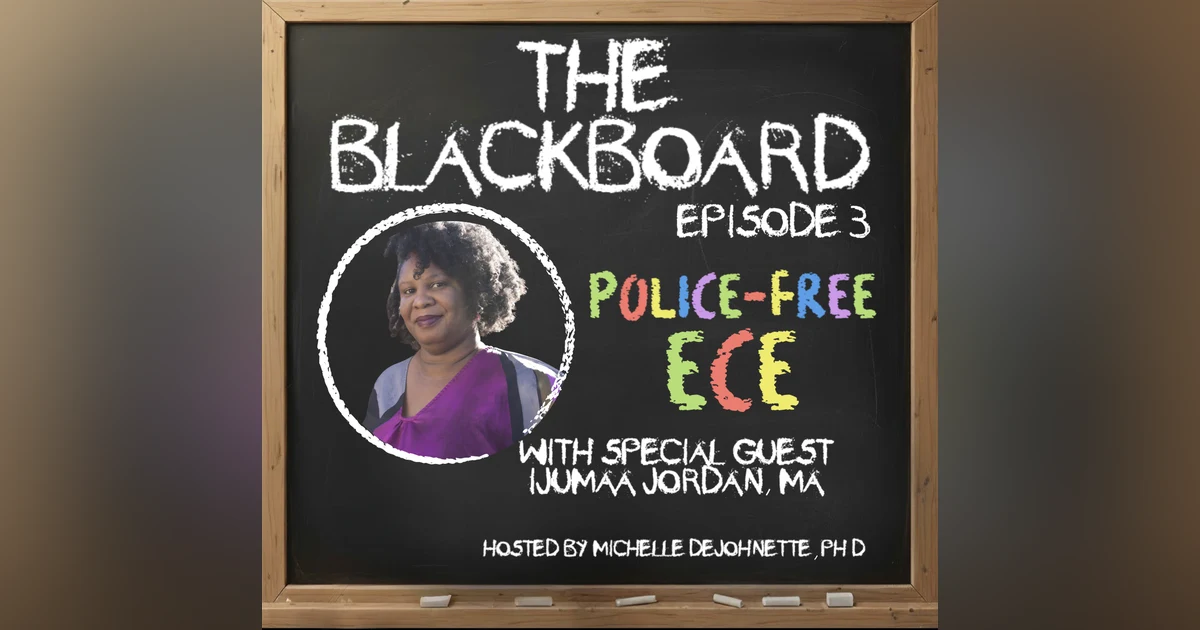


Episode Summary
What happens when the message we teach young children doesn't match the reality many families live every day?
In this episode of The Blackboard, Dr. Michelle DeJohnette talks with educator and abolitionist Ijumaa Jordan about why it's time to rethink the idea of police as "community helpers" in early childhood education. Together, they explore how children from different communities experience policing in very different ways—and why those experiences matter in our classrooms.
They discuss what children learn through play, books, classroom visitors, and everyday conversations, and why educators have a responsibility to make space for honest, thoughtful discussions about safety, justice, and community. Rather than asking what we should remove from the curriculum, this conversation asks what we should teach instead.
Whether you're an educator, parent, student, or community member, this episode will challenge familiar ideas and invite you to think differently about what it really means to help children feel safe.
About the guest
Ijumaa Jordan (she/her) is an early education consultant, and has worked across the work lattice of Early Childhood Education as a classroom educator, outdoor playgroup facilitator, college instructor, and various administrative positions. Ijumaa uses a reflective and transformative learning model when working with adults. Her work mainly focuses on anti-racism work with adults in early childhood education, abolition in ECE, play advocacy, and educational leadership. In addition to directly supporting programs in developing play based, anti-bias curriculum for young children and adults. Through speaking engagements, workshops and one-on-one mentoring, Ijumaa brings more than thirty years of teaching in early education and directing. With a strong belief in the value of an equitable, play-based and emergent curriculum, Ijumaa brings her skills and experiences to her keynote presentations and workshops. She has published articles in Exchange Magazine, Teaching Young Children, and has contributed to early childhood education books such as Developmentally Appropriate Practices (2021), Reflecting Children’s Lives (Second Edition), The Visionary Director (Third Edition). Ijumaa received her Basic Core Certificate in Early Childhood Education from UCLA Extension, her BA in Human Development from Pacific Oaks College with a concentration in Early Childhood Education, Emergent Curriculum, and Anti-bias Education. She also received her MA in Human Development from Pacific Oaks with a concentration in Leadership in Education and Human Services with sub-specializations in College Teaching/Teaching Adults.
Workshop links (Please pay the highest you can afford to contribute to those who need support):
Contact Ijumaa Jordan
Website: https://www.ijumaajordan.com/
Facebook: https://www.facebook.com/ijordanececonsulting
Instagram: @ijumaa_jordan_consulting
Register for Police Free In ECE Summer Workshop - $25
Register for Police Free In ECE Summer Workshop - $45
About the host
Dr. Michelle DeJohnette is an Assistant Professor of Early Childhood Studies. Her work focuses on preparing early childhood educators to teach critically and responsibly through anti-racist and social justice frameworks. Drawing on critical theories and culturally responsible pedagogy, her research interrogates how systems of discipline, punishment, and surveillance reproduce inequities and anti-Blackness in Black children’s early learning experiences.
Across her teaching, research, and public scholarship, Dr. DeJohnette is committed to building inclusive, liberatory learning spaces where all children and families are seen, valued, and supported.
Credits
- Cover art by: Emporium Designs; Podcast Branding
- Outro Music: "Lift Every Voice and Sing" Thomasina Petrus & Kashimana Ahua
Stay connected
- Follow on Instagram: @theblackboardpodcast
- Subscribe to The Blackboard Podcast
- Share this episode with an educator, parent, or colleague
Ijumaa Jordan
Doing abolition work in early childhood education is telling the truth.
Dr. DeJohnette
Welcome to the Blackboard podcast. I'm Dr. Michelle DeJohnette, educator, researcher, and advocate for racial justice in early childhood education.This podcast examines how racialized and gendered inequities shape black children's early learning experiences.Through conversations with scholars, educators, and families, we make research accessible, actionable, and rooted in real life because Black childhood deserves protection, joy, and justice. Welcome to the Blackboard Podcast, where we are rewriting the narrative in early childhood education. I'm Dr. Michelle DeJohnette, and I am here with my friend and co-conspirator in this work, Ijumaa Jordan.
Ijumaa Jordan
Hi, Michelle. Dr.DeJohnette.
Dr. DeJohnette
And I am trying to remember when we met, how long have we known each other? So we met at Pacific Oaks College. Shout out to PO.
Ijumaa Jordan
But it was before then.
Dr. DeJohnette
It was before then? So maybe early 2000s at least.
Ijumaa Jordan
Yeah, yeah. Through SDAEYC
Dr. DeJohnette
SDAEYC, when it was called that back in the day. San Diego Association for the Education of Young Children. We are dating ourselves.
Ijumaa Jordan
When you were a Family childcare provider.
Dr. DeJohnette
Oh, my goodness.
Ijumaa Jordan
And I would come to your program. Those were the days.
Dr. DeJohnette
Those were the days.
Ijumaa Jordan
Yeah.
Dr. DeJohnette
We've been doing this work together and separately for many years now. And so thank you so much for joining me on the podcast. And today we are here to talk about police free in ece.So first of all, tell our listeners what you mean by that.
Ijumaa Jordan
Well, police free ECE is the name of the community that I facilitate where we do abolition work. And one of our main ideas is around rethinking police as community helpers, which is very controversial.
Dr. DeJohnette
Very controversial. So let's talk about why that's important.
Ijumaa Jordan
It's important because it's the truth of the reality that the global majority lives with. Especially now thinking about why ICE is getting carte blanche. And I live in the Los Angeles area. We're still under siege.And our neighbors, our friends, our family members are being snatched off the street. And this doesn't just affect adults, it affects children and impacting them through family separation.The stress of not knowing, like, you go outside, you don't know what you're going to encounter. And if you do, like, if your family gets taken away or you get taken away, who knows what will happen to you?And it's already, you know, people have lost their lives in detention. People have been sent to other countries. Right. And that affects children. Like, children have been a victim of these immigration policies.I'm using air quotes if you're just listening. And have been subjected to the cruelty of fascism.And so one of the things that have come up recently is like people as a larger society, like seeing the harm that I was doing, but not actually connecting that to police, which are, is this is the same thing, right? They just have different names and different focuses. Yeah, it's all policing. Yeah, all policing.And so thinking about in early childhood and traditionally like one of the like units and things that people love to do is community helpers. So like mail person, mail carrier, firefighters, teachers, nurses, doctors.And then it said like, like you brought up earlier, before we started recording around the black area, you know, so those are the people. And it's always a police officer, right?
Dr. DeJohnette
And there's always a police officer costume. I'm using air quotes now. Contagious, right? You know, this in a costume in the dress up area, in the dramatic play area.You know, we have princesses, right? We have the firefighter, the nurses, the doctor and the police officer as community helpers.Some people have police officers come to their classrooms, right. And talk about if you're in trouble, you can always talk to a police officer, you know. So tell us, why is that not always true for every community?
Ijumaa Jordan
It's not always true. It's never true. Right. We just had a one year old baby be shot in a car.
Dr. DeJohnette
Yes.
Ijumaa Jordan
Because his family was being racially targeted for stealing. They didn't steal.
Dr. DeJohnette
And what's crazy to me, Ijumaa, is that in that story in particular, and that's a good example of why many communities don't trust the police to keep them safe. Right? So in that story in particular, we have a woman who's accused of stealing. And for me it's so many layers, right.She's accused of stealing diapers. Right. So if I'm stealing diapers, I need the diapers.
Ijumaa Jordan
Right.
Dr. DeJohnette
And so that's one thing, you know, in terms of the compassion and humanity of people. And then also she didn't. Right. But then even if she had, she's driving away. You don't shoot people, no matter what crime they committed.You don't shoot into cars.People driving away, from what I understand, I've never been to the police academy, but from what I understand, you shoot when your life is in imminent danger. If someone is driving away from you, your life is not in imminent danger. We have license plates that are tracked to individuals, right?You write down that license plate number and you go get that person.
Ijumaa Jordan
And police were community helpers. That means that you're not the jury and the executioner.
Dr. DeJohnette
Correct.
News segment
These are the moments after an officer shot at a car outside A Walmart in Mississippi killing a one year old boy. A car with its door open is seen fleeing from several officers who are on foot.Police were reportedly responding to a shoplifting call involving diapers when 1 year old Cohen Wiley was fatally shot while inside the vehicle with his mother and an unidentified driver. According to the Associated Press. His mother, Felicia Wiley, says police were focused on the other adult inside the car.
Speaker D
As we was leaving out the Walmart, they tried to stop her, but I kept walking because it had nothing to do with me. By the time me and my baby got in the car, she came and then they, when we was backing up, they was running out the car.
News segment
In a statement, the Mississippi Bureau of Investigation said an officer shot at the car as it drove toward officers, almost hitting one. A member of the mother's legal team says the evidence tells a different story.
News segment
On the trajectory of the, of the bullets. They come from the passenger side of the vehicle.So that means, at least as far as we can tell now without seeing the video, that the driver was attempting to go away from the officer.
Speaker D
I raised my baby up trying to show them that he was in the car. So she was backing up and she hit a car as I was opening the door. So the door flew back in.By the time I sat my baby down, it was like three to four shots.
News segment
The shooting sparked protests outside the Walmart as the community demands more transparency from police. The officer who fired the fatal shots has been placed on administrative leave. The city announced in a Facebook post.
Ijumaa Jordan
Police aren't supposed to harm people if they're guilty or not guilty because that's not their job. And if they're community helpers, then they should be helping the community. Helping the community.And so if there is violence taking place, they should be able to de-escalate. They should have those kind of skills if there is theft. Right.So maybe you do go after and try to get loss of property, but any property is not, is never a situation where your life is in danger.
Dr. DeJohnette
Where that person deserves to die.
Ijumaa Jordan
Yeah, no one deserves to die.
Dr. DeJohnette
And you. And then of course you don't know who's in that car. In this case, it was a baby in that car who you killed.I'm hoping there's no one, I'm hoping there's no one who feels that they can justify what happened to that baby and to that family.But oftentimes when people get shot, and usually disproportionately, people who look like you and me are shot and the response is, well, they just need to comply or if they would just do what they're told. In this case, I'm wondering if somebody's thinking, well, she shouldn't have been stealing, right?But we don't think about the deeper context in terms of addressing a society in which we live where someone feels that they need to steal diapers because obviously they don't have the money to pay for them or what have you. And so that's a deeper conversation. But back to our point now.
Ijumaa Jordan
But part of that is thinking about, like when we make police, community helpers, that's saying that police help with societal ills, right? That they can be a resource.But if someone is stealing diapers or stealing food or stealing, you know, stealing things that they need, they don't need police, they need resources.
Dr. DeJohnette
Absolutely.
Ijumaa Jordan
If someone is having a mental health crisis, they don't need the police, they need a mental health professional. Right.And so as a society, we decided that for us to feel safe and like it's not even us, The dominant culture, which is white, middle class and up and property owners, that they, as long as they have a feeling of being saved and that there's someone oppressing and keeping the other in check, then we should take our resources, our tax dollars that we all pay and give it the majority to police.In Los Angeles, I live in one of the second biggest city in our nation and the police are asking for more money and it's not going to help our community. It's going to pay for all the cases that they're being sued for. That's where that money is going.And if we, like people get upset in the abolition space when people say, well, we should defund the police, like all those resources could go to making sure, go to making sure the people have food and diapers for their baby, right? That they have basic housing, that they have child care. Right.That people shouldn't have to steal, that there's food, that there's enough food, clean water, recreational spaces, you know, parks, rec centers. So people don't have to be out there stealing, like, you know, for our young people.But they, you know, they shouldn't just be walking around in groups, you know, just causing chaos and like, and doing stuff for kids, right? Like if they had something productive to do, right. And if there was money going to, that we would have less problems.
Dr. DeJohnette
It is important to note that no one has been charged with shoplifting in this case.
Ijumaa Jordan
I just read this morning about LA Unified is going to have to cut their library services because if they budget to balance the budget, that's the place that they decide to cut and they're going to do some other educational cuts in a time that we're supposedly in the literacy crisis. Right. And so thinking of what communities need and what's actually going to help is not the police. And that's just the truth.
Dr. DeJohnette
That's just the truth. And it also. I wanted to go back to what you were saying about defunding the police. I wish more people understood what that means. Right.Like exactly what you said. We can allocate resources to other areas that will improve the community.Whether it's resources for any mother who needs items, for any parent who needs items for their baby. Right. To make sure that people have food to eat.That as you said earlier, if there's someone out in public having a mental health crisis, they don't need the police. You know, and so often people think that the police is who we need to call for everything.And so, yes, we should defund the police, meaning we allocate less funding to policing and more funding for social work, for community work, for resources for people. There should be no one who is hungry in this country.And as you know, living in Los Angeles, I mean, the homelessness and the food insecurity and the cost of childcare, that all of these things affect, affect a whole lot of people.
Ijumaa Jordan
Right. And of course, so doing abolition work in early childhood education is telling the truth. Right.And also the reality of, in communities of color, black communities, indigenous communities, the police. Like you, I grew up, and I know many of my peers grew up that with the message that the police actually aren't safe.
Dr. DeJohnette
And that's the thing that we still, and that has been happening for generations as long as, right. That we are teaching young children that the police are community helpers.Like we said earlier, if you're in trouble, if you get lost, if you need help, you know, you mentioned one incident where the police shot into the car and killed the baby. I'm thinking about another incident where I believe he was an 11 year old boy called the police. His mother told him to call the police.It was a domestic violence incident and the police come and they shoot the little boy.
News segment
Saturday there was a domestic incident at a home and Nikayla Murray was having an argument with an ex boyfriend. She asked her, an 11 year old son to call police. He called police. Darian called police and his grandma, they both showed up.But mom says that when police showed up that they were aggressive. They were banging on the door and trying to kick the door in. She opened the door, she said guns were Drawn.What happened then is that the officer yelled for everyone to come out with their hands up. Her boyfriend ran out. Ex boyfriend ran out through the back door and trying to get away. She came out no problem.She let them know, look there, there's kids inside. 911 Calls said there was kids inside. While her 11 year old son Adarian comes around the corner with his hands up and she says nothing.In his hands, unarmed. An officer shot him in the chest. He was taken to a hospital in Jackson, Mississippi. He was receiving oxygen.She says by the grace of God, he survived.
Ijumaa Jordan
Yep.
Dr. DeJohnette
Because what? Yeah, we've been doing this for years, teaching young children that the police are your friend. The police are who you can trust.The police are who you go to if you're in trouble. There are communities who love the police, trust the police. You know, they want the police in their neighborhoods.They've never had negative interactions with the police. They don't have to worry about getting pulled over all the time and getting their face thrown on the ground.
Ijumaa Jordan
And that's primarily white communities.
Dr. DeJohnette
Absolutely. Are we in education, which we know is an institution that upholds whiteness and racism and inequities.And so these institutions, whether it's preschool, K12 or what have you, or maybe early elementary, I don't know if we're teaching police as community helpers in 10th grade or what have you.
Ijumaa Jordan
But you have it in police resource officers.
Dr. DeJohnette
Oh, that's right, I forgot about that.
Ijumaa Jordan
And they talk about if something happens like, oh, you need to tell, you know, there's. If you see something, that's who you go and tell.
Dr. DeJohnette
Right. So we're ignoring that. Police in your environment is a positive, safe, productive thing. We're ignoring that.That's not true for other communities, right?
Ijumaa Jordan
Yep. To uphold whiteness, to uphold the dominant narrative, to uphold the feeling of safety.
Dr. DeJohnette
Because when we think about school curricula. Right. We forget. Some people forget. From whose perspective are we teaching?
Ijumaa Jordan
Yes. Right.
Dr. DeJohnette
And so we're, that's what we're centering and we're ignoring the experiences of people, communities who are historically marginalized.
Ijumaa Jordan
Yes.
Dr. DeJohnette
And so we talked about funding and early childhood centers in the dramatic play and the block play areas and even school visitors and why we need educational spaces to remember to acknowledge that this is not true for everyone in your class. So tell us about this upcoming workshop that you have. It's July now. My goodness.So you have a workshop coming next month where you're going to talk about this and you're going to give some practical application information to people who might not know and maybe never thought about this perspective of this topic. So without giving any spoilers away, tell us what attendees who register for this workshop have to look forward to.
Ijumaa Jordan
So we're going to expand on the conversation that we just had. So that was like the preview of what, what we'll be talking about fuller, especially thinking about ice, thinking about policing.And we'll also bring in and talk about the mindset of policing that we as adults do to children, right?Because one of the reasons that I've researched and have experience with is that if teachers, some teachers think and have said to me, well, if we don't have police as community helpers, can't you just say that about teachers? And I was like, yeah, you can say that about teachers, right? Because maybe some teachers aren't safe.But when we think about policing, particularly here in America, that it's a system that was never meant to keep us safe.
Dr. DeJohnette
It was never meant to keep us safe, right? And I think that's another missing piece that people are not aware of the history of policing, right?
Ijumaa Jordan
So we talk a little bit about that. I won't get into it because there were a whole history lesson, right?We'll talk about that and share some resources about that because that's important information to know. And also the term for us to think that police and people in authority, people that support, that are agents of empire, is assumed virtue.We assume that if someone's a police officer, that they're about justice, that they are safe, that they are going to protect and serve. Because, you know, a lot of times that that's what they say on their car.
Dr. DeJohnette
That's what they say on their car,.
Ijumaa Jordan
Right?
Dr. DeJohnette
To protect.
Ijumaa Jordan
And also what children know and understand. And if you watch their play, like when they're police officers, that's about power.Like, they understand that police have power, that they have gun, they have cars with sirens that people have to get out their way, right? And we'll talk a little bit about propaganda, have maybe some, a little bit of criticalness about paw patrol, right?Like, every generation has something that says, the police are good, the police are community helpers. It's in the air and we're raised on that and we get those messages.So we're going to trouble that and critically look at that and then think about how that impacts. Because it's not just about taking away,.
Dr. DeJohnette
Right?
Ijumaa Jordan
Like, you go back to school, you go back to your program, you go back to your family childcare and like, just take all of it out Like, I don't want you to do that. I want you to have a conversation about that. Right, Right. I want you to talk to children about some new information, right.That you learned as a teacher. You actually don't have all the answers. You have to go learn. And so thinking about, hey, I learned about this and I want to talk to you about it.
Dr. DeJohnette
Right?It's important to, you know, we talk about this all the time and I talk about it with my students, that you have to get to know the children and families you're serving. Right. Oftentimes this standard curriculum is just repeated, right. Year after year. And this assumption is that the same curriculum works for everyone.And you and I are very emergent curriculum focused. And we understand that the way you teach and what you teach can and should change depending on who's in your classroom. Right.And so I'm reminded of a study that I read or was presented at a conference.I can't remember, but I believe it was a Head Start in D.C. and during playtime, they put the teacher in handcuffs and told the teacher, you're going to jail. Right. Well, we know it's predominantly black area in D.C. where this was happening, but this was Head Start. These were young children.And so as we know, children's play is a mirror of them. You know, they are trying to figure out their lives, what they see, what they hear, Right. They're making sense of their world through their play.And so these children have seen this. They've seen somebody in handcuffs, right. They've seen someone go to jail. So back to your point about having the conversation, right?And us understanding the community that we're serving. So, yeah, ask the question, what has been your experience with the police, you know, yourselves and your family?We also know that the police are handcuffing children. Right. You know, I researched the disproportionate discipline of black children in preschool in my DOC program.And so we know that young children, their six year olds been put in.
Ijumaa Jordan
Handcuffs, that's four and five year olds, that four and five year olds being.
Dr. DeJohnette
Put in handcuffs, usually black children, or circumstances or behavior that their white peers would not have the same result, right? Crystallizing normal child behavior, developmentally appropriate child behavior.But it is perceived differently when that behavior is exhibited from a child in a black body.And so there's this miscommunication, right, that police are community helpers and police will come and put me in handcuffs, detain me, detain my friend or family member. Right? And so, yes, the conversation must be had.And I think this is one of the very important ones that our schooling system would like to marginalize. Right. Push to the side. Because we don't center the experiences of black and brown families.
Ijumaa Jordan
And we want to have a system that upholds that power. Right. Because if we start questioning police, then we have to start questioning our school policies, our discipline policies.
Dr. DeJohnette
Yeah, yeah.
Ijumaa Jordan
And so one more thing. I'm going to introduce our shiny sticker project.And that's come out of conversations that I've had with police and ECE community members that have young children. And when you're out in the community, one of the officer friendly activities that police do is give out these shiny star stickers. Right.And multiple parents have said, like, it's so hard to like, say, oh, no, thank you, and like, your kids, like, look at that cool sticker. I want that cool sticker.
Dr. DeJohnette
Right. And again, going back to what you were saying when you were going to talk more in the workshop about propaganda. Right.And because everybody knows children love stickers.
Speaker D
Right.
Dr. DeJohnette
And so we're reinforcing this message that police are your friend and we're gonna give you sticker, you know, and the shining star, I wanna explain a little further for our listeners is that pretend, quote, unquote, badge, Right. That star is representative of authority in a sticker and. Or the sheriff's badge or the police officer's badge.
Ijumaa Jordan
Right.
Dr. DeJohnette
And what does that mean when you're giving these trinkets in order to gain community support or the admiration of young children? And so that's a future project that you are going to implement in the community and, and ask for participation. And I think that's really important.I think all of this is important.But when you can get the community to understand a perspective that they may not have thought about before and also get them engaged in the community work to dismantle. Yeah.
Ijumaa Jordan
So those are the highlights. And, you know, if you can't tell from this conversation, I'm fun to learn with, we'll have a good time.
Dr. DeJohnette
She is definitely fun to learn with. She has taught me many, many things over the past, oh my gosh, 15 years or so.But I want to end with what I'm calling our implication and application segment, where I'm thinking that there is always a broader impact. Right. To our, to our work. Right. So what are the broader implications of this work in your works?
Ijumaa Jordan
Yeah, so one of the broader implications is disrupting the preschool to prison nexus. Right. So part of letting go of police as community helpers, being able to examine Our power. Right.Because that means that we are then going to look at, like I said before, our policies and practices that are finally our black and brown children into the justice system. There's the air quotes, right? And like destroying our children's lives. And that's not. That's what the system wants. That's not what I want.I know that's not what you want. That's not what we want for our children. So it's important that we do this work.And it starts, right, it starts with young children and it starts with us as parents, educators, community members.
Dr. DeJohnette
How do these frameworks challenge existing narratives or policies that shape early childhood education?
Ijumaa Jordan
Yeah, it challenges it by saying that our children aren't inherently evil or bad.
Dr. DeJohnette
Yes, they're children.
Ijumaa Jordan
And that they should be able to make mistakes like their peers. And that is our responsibility to help them, you know, quote, unquote, make good choices. Right. Be a productive member of society, not harm people.Like preschool teachers love to say, use your words, right? Like those skills that we need for life, that that's our responsibility.And sometimes some people, I'm not going to say it's your listeners, but are in, in early childhood to use their power over children.
Dr. DeJohnette
Right.
Ijumaa Jordan
And we need to move towards restorative justice models.We need to move towards power with children and empowering children to know how to use their own power that doesn't require hurting, harm or punishment. And so doing this work, that's the bigger impact.It's not just individuals, it's about systemic change as well, and that we have to do both of them to have the society that we say that we want to live in.
Dr. DeJohnette
I wish more people really understood the statement you just made. It is less about individual and more about systemic change.And so I hope that practitioners and educators, policymakers, will listen to the knowledge that you have to share with them and understand how they can apply it in everyday spaces. Before we go, I want our listeners to know how they can stay connected with your work. So where can people find you?
Ijumaa Jordan
I'm on the Internet sometimes. Ijumaa Jordan Consulting on Facebook and Instagram.I have a website, ijumajordan.com you can sign up for my monthly newsletter or I share resources and what I'm getting into.And you can email me like that'll be in the notes if you have questions or you want to join us in our work or we just want to be friends for like 15, 20 years. Like Michelle
Dr. DeJohnette
Thank you so much, my friend, for joining me on the Blackboard podcast. I knew this was just we can't talk without laughing and smiling, which is really amazing.You know that we are able to stay in this work and stay on this mission for so many years together, but still are able to find joy in the work, right? I mean, it can be, it is very serious, you know, arduous, heavy, but we find joy in the work. So thank you for being here,
Ijumaa Jordan
Thank you for having me
Dr. DeJohnette
And thank you all for listening to the Blackboard podcast. If this conversation resonated with you, share it, cite it and bring it to your classroom community.Also, please register for the upcoming workshop police free in ECE with Ijumaa Jordan, happening on August 23rd. And we will add a link in the notes as well for people to go to to register for the workshop.And you can find other episode resources and transcripts in the show notes. Until next time, stay critical, stay grounded and keep imagining liberatory futures for Black children.Is1 oh last march on till equity equity is one one love let us march on till victory is one.


