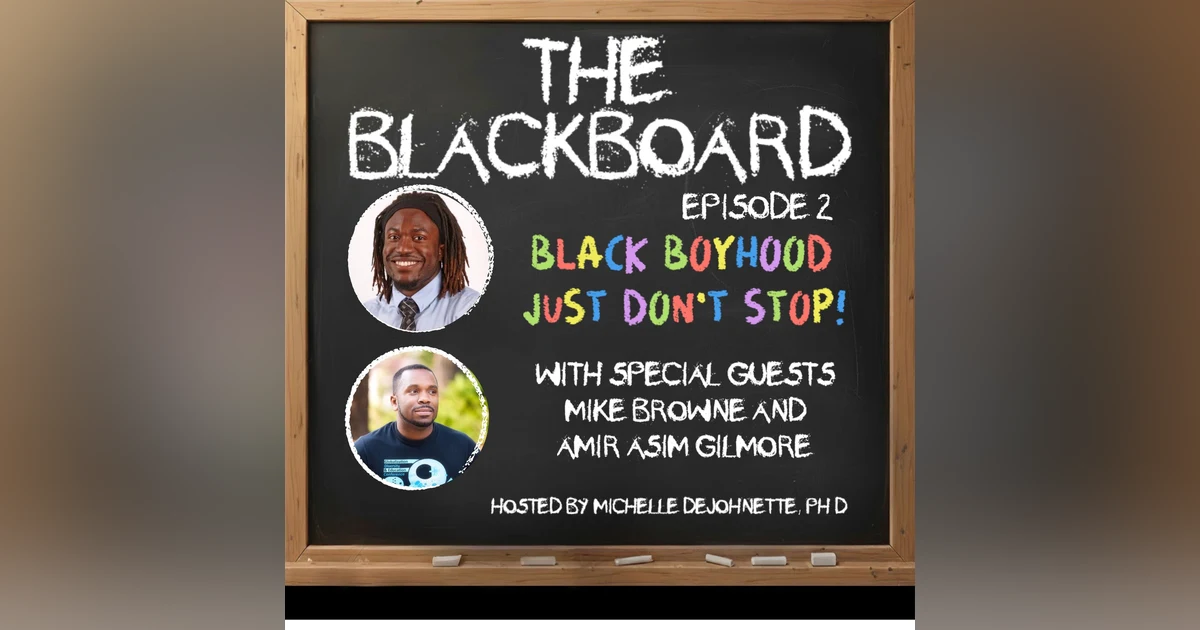
Black Boyhood Just Don't Stop


Episode Summary
The conversation presented in this episode underscores a crucial and stark reality: the adultification of Black boys within educational and societal contexts. This phenomenon, which effectively robs them of their childhood, manifests in the premature attribution of adult responsibilities and expectations, thus leading to severe repercussions for their psychological and emotional development. As we delve into the narratives shared by our guests, Dr. Amir Gilmore and Mike Brown, we explore their insights into the necessity of recognizing the complexities of Black boyhood—characterized not only by its challenges but also by its joys, aspirations, and inherent worth. Through their reflections, we aim to illuminate the systemic inequities that shape the experiences of Black children in educational environments and advocate for a more compassionate and nuanced understanding of their identities. This dialogue invites educators and listeners alike to engage in meaningful reflection about their roles in dismantling these inequities and fostering environments that celebrate the brilliance and joy of Black childhood. Ultimately, we emphasize the imperative of ensuring that Black boys are not merely seen through the lens of deficit but are recognized as vibrant and deserving of every opportunity to thrive.
About the guests
Amir A. Gilmore, Ph.D., is an associate professor of Cultural Studies and Social Thought in Education and the Judy Nichols Mitchell Faculty Fellow in the College of Education, Sport, and Human Sciences at Washington State University (WSU).
As a Black interdisciplinary scholar situated in Black Cultural Studies in Education, Amir’s broad research interests are Black Aesthetics, Black boyhoods, Black futurity, antiblackness, and the political economy of schooling. Amir’s current research unequivocally examines the nuances, complexities, and specificities of anti-blackness and how Black people are routinely dehumanized and subjected to physical, psychological, intellectual, and epistemic violence.
Mike Browne (he/him) is a New York–raised Afro-Caribbean educator, coach, consultant, and storyteller. He co-hosts Napcast, a podcast on early learning, race, and social justice, and Parallel Play, the Office of Head Start’s national podcast on toddler development. A former tap dancer and collegiate athlete, Mike lived and worked in London, Spain, and across the U.S., bringing a justice-centered, relational approach to early learning. He centers his work on ancestral wisdom with a modern twist, adapting the lessons of the past to guide children, families, and educators in reclaiming culturally grounded practices and joy in learning today. Tune into Napcast wherever you get your podcasts, and follow on Instagram @napcast206 or Twitter @miguelitobrowne.
About the host
Dr. Michelle DeJohnette is an Assistant Professor of Early Childhood Studies. Her work focuses on preparing early childhood educators to teach critically and responsibly through anti-racist and social justice frameworks. Drawing on critical theories and culturally responsible pedagogy, her research interrogates how systems of discipline, punishment, and surveillance reproduce inequities and anti-Blackness in Black children’s early learning experiences.
Across her teaching, research, and public scholarship, Dr. DeJohnette is committed to building inclusive, liberatory learning spaces where all children and families are seen, valued, and supported.
Credits
- Cover art by: Emporium Designs; Podcast Branding
- Outro Music: "Lift Every Voice and Sing" Thomasina Petrus & Kashimana Ahua
Stay connected
- Follow on Instagram: @theblackboardpodcast
- Subscribe to The Blackboard Podcast
- Share this episode with an educator, parent, or colleague
You can't say you value this anti racism in your 9 to 5 and then go home and get in bed with white supremacy.
Michelle DeJohnetteWelcome to the Blackboard podcast. I'm Dr. Michelle DeJohnette, educator, researcher and advocate for racial justice in early childhood education.This podcast examines how racialized and gendered inequities shape black children's early learning experiences.Through conversations with scholars, educators and families, we make research exciting, accessible, actionable, and rooted in real life because black childhood deserves protection, joy and justice. Welcome everyone to the Blackboard Podcast. I want to introduce my guests today.I have with me Dr. Amir Gilmore and Mike Browne, co authors of the article one of their articles is Black Boyhood Just Don't Stop. A reflection of the necessity of meaningful boyhoods. Welcome, gentlemen. I'm so glad to have you here.I'm really excited about this conversation and thank you very much for being here. Tell our audience about yourselves, what you're doing, where you're at. Tell us about yourselves or I'll go first.
Amir GilmoreAmir Gilmore here, associate professor in cultural studies and social thought in education at Washington State University. Hashtag Go Cougs. Teacher educator by trade. So I teach teachers, how to be teachers, secondary ed focus. A lot of work is in equity inclusion.My doctoral research conceptualized black boy joy through the notion of black aesthetics, primarily through jazz and, and now as a researcher, scholar, nerd person, a lot of my work looks at the notion of anti-blackness in education society and really how that relates to black people, but primarily black children and then specifically how black boys, how does that really affect black boys on the day to day? And yeah, I'm happy to be here. I'll turn it over to my homie, my boy Mike and he can talk about who he is.
Michael BrowneYeah, I appreciate y' all and appreciate being here, being community with y'all. So my brown pronouns are he, him. I always think, how do I like to introduce myself?And I think I'm Googleable, you know, I mean if you Google me and you find a white person, that ain't me. So look for the Black boy. But so many more things than what a resume might say, a C.V. might say. On a C.V., if you want the professionalness you got.I'm infant toddler educator. I'm on the traditional lands of Kumaya tribe, which is now known as San Diego, California by colonizers. I do improv. I do so much different things.Like I'm on podcast, writing articles, hanging out by the pool. I'm just trying to do it all. But what you really don't see on the resume is that, like I said, I did improv for a little bit.I used to actually do tap, jazz, and ballet for about six, seven years. And then that actually helped me transition into playing Division 1 football back on the east coast, where I met Amir at the University at Albany.So I like to say I live several different lives that you won't ever see on a resume, including living and working in London and Spain for about four years. That's when I didn't have any all these gray hairs when I had two good knees.And so, yeah, that's what I'd just be doing and just hanging out and showing love to people of color, people of all races, genders, religion, creed, all that fun stuff so that we can change the world.
Michelle DeJohnetteYou two are so amazing. You are so amazing.We talked before, but now I'm learning more stuff about y'all, and it just speaks to even more so more deeply to the brilliance of black boys.
Amir GilmoreRight.
Michelle DeJohnetteAnd the brilliance of blackness. I had no idea that you had all these talents that you hadn't shared with me before. Mike and Amir, you forgot something, right?You are now a tenured professor.
Amir GilmoreYes.
Michael BrowneWhat?
Michelle DeJohnetteCongratulations. Congratulations. So let's get right into it. My first question for you is, what inspired you to write this article?I know you have others, but this article, black Boyhood Just Don't Stop. A reflection on the necessity of meaningful boyhoods. What was the inspiration for this article?
Amir GilmoreMike, you want to take this one or should I go first?
Michael BrowneYeah, we wrote that a couple years ago, so. Oh, man. I think there's got to be a variety of different reasons. First of all, I think we were just listening to K Dot too much. Kevin. Not Kevin.I'm already messing up. See, don't take away my black card, y'all. Kendrick Lamar. We was listening to Kendrick Lamar. We were just vibing out.
Amir GilmoreWe were.
Michael BrowneI had just switched schools, so I was in a different new early learning program. And I think maybe at that time, Amir and I, we had just linked up after a little bit, and we just started. It was like we never left, right?So we went to school together, and then we'd been in each other's lives from 15, 20 something, couple years, a couple gray hairs now. And I think just through reflection, we were just talking about, man, how could we go back to when things were more simple?But also, how do we now, as adults, reclaim that boyhood? And then out of that conversation, I think it just kind of materialized. We were talking about, well, man, black.Black childhood, Black Boyhood, it don't really stop. We still recall a lot of the things now as adults. All of our dreams and our wants and our hopes and our wishes, they never really left us.And so how do we reclaim that and how do we rekindle that? And then how does that allow us to guide us, our work with whatever space that we're in? And so, from my point of view, that's how it happened.But it could be radically different. Amir, what you think?
Amir GilmoreYeah, Mike and I, we have been. We've been boys forever, right.And I think some of the impetus for me was like, I was reading this is a little after my finishing my PhD, my dissertation, Michael Dumas's and Joseph Nelson's work on black boyhoods. The reconceptual of black boyhoods was really powerful for me.And again, that notion of how black boyhood really doesn't stop, it kind of keeps going on this progressive level. And it really made me think about how me and Mike, our boyhood joys are still kind of with us. Right.I even think about my connection to my dad and, like, how I love jazz. Right. That's a big joy of mine, is listening to jazz. And that really came out of my boyhood.So I reflect hard on that notion of, like, how our boyhood joys is something that kind of keeps unfolding into the future.And the importance of that, I guess, also maybe to underscore some of this, is not a lot of people talk about boyhood or black boyhoods in particular, right. I don't think there's enough research, enough scholarship, enough people talking about black boys. I mean, I think there's a lot of people that.There are researchers, early childhood educators that talk about boyhood or work with boys, but don't really talk, conceptualize and think through the importance of boyhood or the multiplicities of boyhood. And what does that mean, especially, again, for black boys in particular?Some of my research also looked at adultification and, like, how by the time a child, maybe like seven or eight, they're no longer a boy. Right. Being a black boy really doesn't last that long in this world.And so really, for Mike and I, really get early childhood educators to be more expansive when we think about boys.And boyhood, especially when it pertains to black boys, is so powerful because we do a lot of truncating as educators, as adults in the society of limiting the dreams, the hopes, the aspirations of black children.
Michelle DeJohnetteYou talked about what inspired you to write this article, and I wanted to ask was there a specific memory, a specific observation that kind of sparked this.
Amir GilmoreThat's a really good question, I think, at least for me, again, think about like my experiences again. It's really for I will say I would give to. I think about again, my dad and jazz, right? And so how precious that jazz is to me.Jazz is my living theory. I walk, breathe, sleep, talk. Mike probably gets annoyed at this point. He's, I like, I'm like, Mike, I got this idea. I'm like, improvisation is mayor.Come on now. But I love jazz and right? And I think through jazz, I theorize through jazz, right? And so I think about the embodiment of that.And I got a lot of that from my dad, right? That's passed for me from him to me, right? Even before that, it's passed from my, from my grandmother to him to me. So that's really important.I think also in that article that we had wrote, which is also just like believing in the dreams of black boys, right? And I think how often we as black boys have these ideas or ambitions and how it gets smited just by people every day, right?Like, you can't do this, you can't achieve that, or oh, you would be better doing this. I think in the article we wrote, I think we used Malcolm X as an example.And he had, I think, an eighth grade teacher that said the best that he could ever be was a brickaware, right? And I'm like, we're talking about the Malcolm X, right?So I think about the everyday, like how often are black boys dreams and ambitions kind of just being smothered by just white interests, anti black notions on the everyday basis. Yeah.
Michael BrowneAnd for me, I think I was in two kind of spaces.I think the first space is how many articles are written by black men working in early child education or teacher prep that has written to black boys or four black boys, not just about them, but two. And for them, almost like a love letter for them.And so seeing that there's this space where there's electing, there's missing content, I wanted to be able to write something for that. So I think that's one space in which I was in. And then the second space was just a reflection of my own childhood.How many times have I been told, well, you got to be something else. Well, you can't be that or constantly being told no. And there was no space for yes. There was no space to be, Mike.There's no space to be a four year old whose name a four year old who isn't energetic, right? And so all my other peers at that time was lauded for being a leader, was lauded for being creative. But for me, it was, well, you.You're doing the most, you're doing too much. And so just. Just verbalizing it. And that happened back in the 90s.Now, working in early child education, now, seeing the same things happen, I'm like, there's got to be a stop to this. Who's talking about this? Who's putting a stop to this?And if we're going to change the world, like I always say, it's going to be up to us in early child education. And so how can I advance those messages and stand on the shoulders of already the trailblazers?Because this ain't new, but how can I advance this message and make it more palatable for and modernize it for people working in spaces right now?
Michelle DeJohnetteI love that. And you're so right, unfortunately, right? This isn't new.And so as black men, as you reflect on your own educational journeys, what experiences from your boyhood still stay with you today?
Amir GilmoreI got good, I got bad. You know what I mean? And so I think, I guess in academia land, Roger Carey talks about being like the academic hero, right?And so, like, how black was only loaded for being, like, highly intelligent and really smart, really brainy, right? So the notion of outgrinding your peers to be that black person, to be the smart black kid, right? But I was bright, I guess.I did everything teachers told me to do. I took all the tests. I was brave, smart, like, compliant. And I think about that a lot.I'm like, am I really that much better than other black people or just because I was just complying, I complied to the system as a black boy. Also talking about because I was black and I had the intelligence or I seem intelligent, right? Being called Oreo, right? It has always followed me.They're like, oh, you're not really black, because how dare you want to read and be and have smarts, right? So that has always kind of traveled with me wherever I go, even as a professor to this day. And I'm just like, dang, I can't be black and just be.Be a professor. I got to be like a black white person. And I'm like, what are we talking about? Right? And I get all the said.It gets me very annoyed because if you look at the history of education or the history of black people, being educated was, like, one of the biggest things to do. And so, like, how we have tied intelligence to whiteness. Is so really interesting even to this day.I guess the other thing that I think about in my boyhood experience, I've always wanted to be a teacher, right? That's the only thing I think I was ever really going to be good at. And I used to have an afro, used to have a lot of hair back in the day, right?And I had told my teacher that I really loved, I confided in that I wanted to have grades as a teacher. And I remember him telling me that you can't have grades. Being a teacher, that's unprofessional.And it just cut me in such a way that here I am still talking about 20 years later. It cut me in such a way that it just really changed. It changed me, right?That like, oh, wow, yeah, you could be really intelligent, you could be bright, you could be compliant, you could do all these things. And because I wanted to have grades as a, as a teacher, that was like, that was the bridge too far, right?And so it's just now as a teacher educator, that's something that I really challenge people on. How people appear and how people want to show up and what should they look like, how should a teacher be in a classroom?
Michael BrowneI think the biggest thing I took from that, what you just said, Amir, was you had hair. When that happened, that must have been a different lifetime dog. As I sit here playing with my locks. But for me, I think it's.I don't know if you watch me because I'm literally writing an article and part of what I'm writing in that article literally talks about this. And so the article title, still work in progress is you can't teach what you've never felt. Nature play in teacher preparation.And I'm going to excerpt from that is what I'm going to talk about is, okay, I remember a time when I was younger and Ms. Jennifer, back when I was in Buffalo, New York, right?Ms. Jennifer, a long time family friend, like once told me, all right, after school, you got 10 minutes outside before that cold come and snatches up one of your fingers. And so we have insulin gloves. Growing up, right, all I had was the dead of winter to play outdoors.First time to go inside and do homework and dinner. And I remember just jumping from the steps into a pile of snow.I remember trying to thaw out the icicles I was growing from the railings, from the warmth of my breath. And so in that play, a world was created and it was just a simple joy.I had to just roam free for those 10 minutes without adult like culpability without educators or teachers telling me what to do, without rules, I can literally just be free. I got the dream of and experiment. And think about my aunt who's coming to visit for the first time.And we from the islands, we from Antigua, so she ain't never seen no cold. She thinks 70 degrees is cold. And so she was going to freeze when she saw it was like 10 degrees outside.And then even on the flip side of that, not even in winter, but in the summer months when I remember racing on the streets, but I could never leave the block, and I felt the heat of the pavement rising up and I see the lowriders and the 1980s sedans riding down the street. But I had to watch from the porch or my mama yelling from the inside not to engage with those boys. So outside wasn't just simple for me.Outside was not just nature for me. And I remember these stories, and these stories stick with me even though.And I'm trying to reclaim them, because for so long, I had to bury those stories.Because when I got to professional spaces, they often felt, in quotation marks, too rough, too complicated, too ghetto to belong in conversations, especially when around conversations about childhood. And so those memories is what I'm now trying to reclaim.And by reclaiming that, it's also a reminder that nature isn't separate from our culture, isn't separate from my community, isn't separated from my race or class or survival. And it's not somewhere that I just visited.It's something that informs how I move through this world, whether it's the smell of workers pouring concrete or the sounds of children yelling car as we shuffled out the street so you don't get hit.These are the things in which I remember and reclaim and try to work into my pedagogy and my curriculum so that I'm able to teach toddlers about the vastness of nature, about the vastness of blackness, about the spectrum of blackness.
Michelle DeJohnetteI love that so much. And you just, well, maybe you can expand.But it's funny that you just said that, because my next question was for you and how these experiences that you have had influence how you engage with young children in educational spaces. Right? You want to expand a little bit on that.
Michael BrowneAnd perhaps this. And I go back and forth on how I view this. Perhaps this isn't a burden. I'm supposed to carry, a cross I'm supposed to carry.But also I think about, if not me, then who.And I think about it in the lens of how am I showing children, especially White children, especially rich children, how the spectrum of blackness, right? How can I be the counter narrative to the master narrative?The master narrative is going to tell them that black boys are dangerous, Black men that have locks are predators. All these negative connotations, I don't even know where they came from. We know where it came from. Hundreds of thousands of years of slavery book.This is only hour long podcast, right? And so how can I show them that men can cry, men can be soft, men can miss family members.A practice I always do is when a child is coming in, they're having very big emotions. I don't ever call it a tantrum. I think adults have tantrums because quote, unquote, they're supposed to know better on how to handle their emotions.But for a child who's experiencing anxiety for the first time or separation for the first time, that's not a tantrum, that's just an emotion. And so sharing, oh, hey, little Billy, like, I, I see that you're having a big emotion. I understand that you're missing your mother.I miss my mother, too. My mother lives far away. Do you know how far away is? Or whatever, though. I try to bring in whatever is contextualized in that moment.And I share with them, like, oh, I can be emotional too. Or I'll bring in traditional garments for my culture that looks like a dress, but they're ceremonial robes.And all the children go, why are you wearing a dress? You're not a girl. But that's an invitation to be like, well, what makes a girl? What makes a boy? And we could talk about the spectrum of gender.And so there's so many different things, but it's all about how do we relate it back to the children. And so that's how I build off of things, to be, again, the counter narrative to the master narrative.And I know people are going to be like, well, you're indoctrinating children, blah, blah, blah, blah. Keep politics out of it. Teaching is political. Whatever you teach.
Amir GilmorePolitical.
Michelle DeJohnetteYes. Education is political. Exactly.
Michael BrowneI'm like, if you want to be in the spirit, go be a bus driver, right? Go work in sanitation. They make bank.But we don't need people here who are going to have a limited view of childhood, who don't trust children, who don't trust their own tools in the teacher tool belt.
Michelle DeJohnetteYeah, I love that. First of all, I'm going to have to have you back to talk about play. I teach a class called the Dynamics of Childhood Play.And I talk about black boys play. Right? And how black boys play has been criminalized and racialized, gendered, and their play is inequitable. Right.I know Amir listened to the first episode with Nate Bryan, and so I bring in his work. It talks about and is really rooted in the experience of Tamir Rice. And I don't know if you're aware of Clint Smith's TED Talk. Right.And so I bring these resources in and these stories in so that my college students understand, as they're in the early childhood spaces, that these prejudices exist. Right. And that these experiences exist. And Amir touched earlier on adultification, and we'll talk about that a little bit more.This idea that black boys. And I will generalize. Black children are often thought to be older than they actually are.And then so they experience different perceptions and different consequences. Right. But when you're talking about black children, black boys especially, just being able to play just to be children. Right.And we know that there's a lot of literature out there that shows that their white peers often get the benefit of the doubt and Whereas they get punished. Right. And so I love that you bring those experiences into the classroom.And also just your black body, your black male body with dreadlocks being in the early childhood space.
Amir GilmoreRight.
Michelle DeJohnetteSo just that, to me, speaks volumes. And we need more teachers who look like you. Right.Because we're still combating that narrative that a men don't belong in early childhood education and care and that there must be something wrong or something different or we have to watch them more closely. Right. And then the hair, we could do a whole podcast on hair. And of course, I talk about black girl hair and the issues with that.So I love that you guys are bringing in the issues or the experiences, the perceptions that you also endure regarding your hair. That's still a thing. And I talk about that in class also. And this idea of what is professional. Right.I talk about hair as a black woman, but most of my students are not aware of the issues that black girls have with their hair and how our hair has been categorized as ugly, nappy, unprofessional. So much so that there is a law here in California. The Crown act was 2019. Right. That now it's illegal to discriminate against our hairstyles.2019 Was practically yesterday. Right. When we talk about the historical context.And so you guys are bringing up such excellent points that, like we said before, we're still grappling with, and we have been for generations. Amir is talking about being called an Oreo or the expectation that you're not Going to do A, B and C because you're in a black male body.
Amir GilmoreRight.
Michelle DeJohnetteThough we as black people have always sought after education right? Back from slavery when we were not allowed to be educated.
Amir GilmoreRight.
Michelle DeJohnetteWhen it was illegal for us to learn how to read. Right. And we know why that is.So there's this idea, this narrative that we aren't as intelligent or we can't be or we can't accomplish, or there's something different about a black person wanting to read. Historically, we have always wanted to be educated. Right.It's just amazing to me how all of these stories, experiences, this narrative that we have to counter. All of this intersects still in 2026. So back to what you said earlier, Mike, about this love letter.The article opens with this series of statements addressed to educators and institutions that attempt to diminish your identity. And now you seem to be writing to not only yourselves because your boyhood is still there, right? But then the next generation of black boys.Why did you feel it was necessary to address educators in that way? Or even black boys for that matter?
Michael BrowneI think a lot about how we talk about representation and how that matters all the time. And so to keep it 100. Can I keep it 100? Kill my father? No, you get that Chappelle show reference,.
Michelle DeJohnettePlease keep it 100.
Michael BrowneI think also part of the writing and even just the process of writing goes back to what me and my therapist Judy talks about. What's up, Judy? If you're listening, appreciate you.But also side note, like y' all black men, black people, black and brown people, melanated people, please go to therapy. Go use your employee assistant program like your eap. It is there for a reason. Mental health. We all got to talk to someone, right?Sometimes Judy, just be like, you done. All right, that was a good vent session. Now let's make some solutions. Anyways, I think I bring that up because it's healing. It was healing.So there's a lot of inner child, little four year old Mike that needed to be healed.And part of what I feel now as an adult in my personal and professional relationships is just the need to feel heard, the need to feel seen, to be valued. And so that has carried my work.And it started in our, even in our first article that Amir and I wrote about black boy Joy just being visible and validated for who I am. Because like I said, the four year old within me still has, is still coming out to this day.And so in a nutshell, I think that's why it was so important for Me to start off this article like that, to directly address systems communities, black boys, black educators with. I see you and as black male educators, deeply committed to black boy joy, brilliance, resiliency and educational well being.We have to talk about this, we have to speak about it, we have to theorize about this and we have to make changes about this.
Amir GilmoreYeah, a lot of times people say that they know black male care about black men, but if man speaks about their own experiences, like how that kind of gets like maligned or sidelined. And so I, I think even for us, even just to write this piece about our experiences and the importance of that.And I've been through my own issues, my cast.And so we've been through the struggle together as black male educators and really just to talk about, talk about black being a black boy from our perspective. But I don'. We think about the future. Always got to have the future in mind because like you don't think about the future. We're gone, we're cooked.Right? So what happens after me? Right? What happens after us? What can we leave behind? What do we want black boys to like inherit from us as grown men?How can we foster a world where they can be joyful? Right. That they can be like that 4 year old black kid that's like running around, it's like minding the business, living their life. Right.That's what I really want in this world. Right. And so I think we take that aim to educators because. And I'll be, I guess, keeping 100.A lot of white people think that they care about kids, but when you press them on the issue and when it comes to black people, they're like, what? And, and so there's such a shortcoming, right. When it comes to like white educators working with black children, especially like black boys.And I'm just like, well, you claim you love all kids, you claim that you do anti racism and DEI work. But when we start talking about some of these issues that involve race, right?And then we think about the intersections, every people just be, get, they get quiet. They don't know how to talk about certain things. Right. Or they don't, oh, that's not really racist.Or that, that wasn't, that's just Sally, you know how Sally can be about children. And so all these excuses, right. Or the lack of social awareness.And I'm like, this is the wrong field for you to be in, to lack such social awareness. You're working with other people's kids.
Michelle DeJohnetteRight.
Amir GilmoreAnd I try to remind preservice teachers And I'm like, black people are giving their biggest gifts to you every day, their children.And you better have a social responsibility of teaching them, of loving them, of caring for them, of really making sure that they see themselves as possibilities.And so when I, like, listen to what people say about children, especially, like, black children, I'm just like, this is not the space that you should be in. Right? And I think I laugh. Well, joking.But seriously, the hardest thing is to tell a white person that they shouldn't be a teacher because they feel like they could be anything in this world. But as soon as I say, I don't think this is the job for you, they're like, oh, buddy, who are you to tell me?But, you know, I listen to what they say, what they don't want to do. So at this point, I'm a little tired of it, right? So I'll just say this, and then we can move on.Or maybe, Michelle, you might have some other thoughts. We're at the point now that I have teachers that want to be teachers, and I'm like, great. And I'm like, will you read these books?And they're like, you gave us too much to read. And I'm like, well, don't you want to be a teacher?I was like, how could you say that you will care about kids, you care about this profession, a profession. But you don't want to read.You don't want to engage the work, especially the critical work that might implicate you and your whiteness in this work, in this profession, right? And so I'm like, no. I'm like, you can't do this work. Right? Please leave.And that causes the biggest tension for me as a teacher educator, because as a black person, I was like, you better read these books. Because you go back a few years, we couldn't read books. It was illegal.You're telling me that you're too busy or you don't have the time or you know everything that you need to know, but somehow when I question you on race and racism, you just don't know. And so it's just a lot. And maybe circle this back to dovetail again.I think about the future of black children and black kids, and I'm just like, well, if I know how the sausage is being made in this factory, I am very concerned about the children that come after me because I want something that's better for them. I really do. And I'm fighting like hell. We're fighting like hell to make that a possibility. But it's Hard. It is really hard.
Michelle DeJohnetteIt is extremely hard, and it's heavy. And we don't have time to get into the. Our college students not wanting to read. That's a whole nother conversation.I don't understand it personally or professionally. Right? Because similar to you, I was always a reader, and so reading was fun for me.And I always had this intellectual curiosity, but these students don't have that. These students want to check the box and pass your class. I tell my students similarly that this is personal to me.This is what I do because I research racism and inequities that are happening in early childhood spaces. And we have enough incompetent teachers in school. And I need you to leave Dr. DeJonette's class with new knowledge, right?And I need you to graduate having this knowledge, understanding what racism in early childhood looks like and understanding your own biases. And I need you to go out there and interrupt what's happening, right? And so for my class, it's not just about checking a box.I need you to do the work because I need you to have the understanding. So you're right. It's a lot of work. Let me ask you this.One of the arguments that you two make in this article is that black boyhood is often misunderstood. And to me, that is connected to what you were saying about talking to white teachers.We know the teaching profession is predominantly white and predominantly women, and we have heard the colorblind narrative ad nauseam, right? And, well, why is there a difference? Right? I just treat all my children the same.And again, we're doing the work of trying to counter this narrative that, no, it's not the same. Culture matters, right? Background matters, ethnicity, language, funds of knowledge, all of these things matter, right?And what I say is, if you want to teach, treat everyone the same, right? Or if you don't see color, then what does that mean? Everyone's white. And of course you see color.You stop when you're driving, you stop when the light turns red, right? So you see color. What you're doing is evading race and skin color, right? When you look at me, you can't not see I'm a black woman.You can't not see that, right? But if you want to push past that, you want to not see that, and then you don't see me, right? You don't see all of me. You don't see my experiences.You don't understand or want to understand or realize that my experiences may be different than yours, right? But if we take that context and that black boyhood is misunderstood in educational spaces.How would you define black boyhood for educators, especially early childhood educators? And how does that differ from dominant social narratives of black boyhood? Amir, I'm looking at your face.
Amir GilmoreIt's a good question. Cause I'm just like. It just. I feel like it just layers upon layers of context, right?Because I think, I think about, in some vein, like I think about black boyhoods of being like, again, joy, exploration, fun, but also just like rushing tumble. But there's also like softness and sensitivity of being like a young boy. Like, you're just like out there, right? And just like living the life. And.
Michelle DeJohnetteAnd I'm sorry, I'm wondering if that softness and joy is ignored or it's not seen. So it appears as if in some people's minds they can't coexist, right?You have the rough and the tumble, I've been told the aggression and the troublemaker and all of that. But we're not hearing a lot about the softness and the joy, the vulnerable, right? When we're talking about little black bodies,.
Amir GilmoreI think that there's something, I guess it goes into people's preconceived notions of like how they see uncode black children, black boys, right? Or what they expect or how they expect to show up. And I was a soft. I was a soft ass kid. I'm still a soft ass person, right. I'm very sensitive.I am an empath, right. So I feel stuck. Right? But I may not always show it. Right. And I think how that translates into this world is so always interesting. Right?And so I'll give you a quick story. And I know that Mike will have some thoughts too, right. This week, maybe first or second grade, I was a very quiet kid as well.I read, I did all my work. I was. And there was a test in second grade. You got to read a passage making no mistakes. And I read the passage, made no mistakes.And everyone was really surprised. They're like, oh, we didn't know Amir could read. And I'm like, yeah, I could read. I just didn't want to talk, right?And they were using this, this marker to determine if a child needs special education. And now as a grown man, I think about how wild that is that my. My educational outcomes really depended on.And they made so many judgments on me just because I was a quiet kid and I hadn't talking. And I'm just like, that is. That's a lot to really take now. So I think there's all these misconceptions and notions and judgments.Black boys, black children, black communities, or again, this rugged, male, hard bodied person. And so I got called a lot of things that I can't say on a podcast because I was a soft little kid, right?And again, that stuff still stays with me and I'm just like, well, how should I express my masculinity? Because if I express my masculinity in the way society tells me or I should, I will either be in jail or I be. Might be murdered by police, right?And so I think it's so interesting, it's damned if you do, damned if you don't, because of how society really puts you into a box and you're supposed to just, just struggle out of it, really.
Michael BrowneAnd it's so fitting because what you're talking about, putting black boys and black men into boxes, it's the same thing that we do with our toddlers. We tell them this is what you can do and you can't do. This is what you should do and you shouldn't.We use the word should all the time while forgetting that this might be the first time that they're experiencing this rule. This might be the first time in months because we talk about rules in September, but we don't ever talk about them again in December.We don't ever reinvent them or reimagine them to fit their development in March. And so we stay stagnant. And then on top of that, we've been doing the same curriculum activity since 1984.You got to update the the times because the activities that you did yesterday or last year worked well for the children in your environment then, but it might not necessarily work for the children today, especially when they're coming out of COVID So Covid babies, they are, we live in, even in an even more capitalistic society. And there's the influence of AI and screens and technology and instant gratification. And so we got to do something different.We can't just keep doing the same old thing that we've been doing for 20, 30 years. So that's the first thing. The second thing is I touched a little bit about this. I love writing.So I touched a little bit about this in another article that I wrote called Men Risky Play and Gentle Care, the Tenderness They Didn't Expect. And so, and that's published through Exchange magazine, which is all free.You sign up for, you can sign up for free on Exchange magazine and then you get access to these articles. But essentially I start off that article where my director at the Time calling me in and say, hey, Mike, the children, they love your expressiveness.They love your energy. They love how everything about you. But can you tell me a time?And of course, this director is white, but can you tell me a time when you've been soft with a child? And so I go through that article and thinking about, okay, this isn't the first time I've heard a question word like this or not soft.They use the word gentle. Can you tell me a time that you were gentle with the children? And so I go through this article, and I go, okay, there's four options that I can do.And then I go into themes. And one of the things that I talk about is just around reclaiming roughness. And so playing Division 1 football taught me a lot of things.Yeah, it taught me to be physically tough. I got to be assertive. I got to be loud, resilient. I gotta have grit. All these things.But what they don't talk about on TV or talk about enough in culture, right.Is that it's those moments in between the plays, because you're only playing football for seven seconds at a time, and then you got 30 seconds off, but in those 30 seconds, you're in a huddle with 10 other players. And through that, I get to learn what each player on my team, what are their needs in this moment?You see body language, you see their pain, you see their joys, you see their celebrations. And then in that time, you also learn what it means to hold space for others. And so I question that article. Why do we see rough?I questioned that article. What if roughness or being rough isn't seen as the opposite of care? Because in my culture, it's seen as communal.It's rhythmic, it's intentional, it's healing.
Michelle DeJohnetteWow.
Michael BrowneAnd so I'm always thinking about, how am I reclaiming this roughness? How am I reclaiming movement, Sounds, touch. And by doing so, I'm actually refusing to label those things as harmful.And it goes to questions like who gets to decide what kind of play is safe and what kind of play is aggressive? And how are we mistaken confidence, volume, rough movement for a lack of care? And we also need to expand the definitions of gentle.Because how I learned it growing up in my culture is that it's not just having a soft voice, but within the context of risky play. I'm emotionally and energetically in tune with these children.When we're running around and we're playing monsters on the courtyard in the playground, and I see a child stops, I can stop On a dime, when a child says too much and I support them in thinking about this language that they want to use, or they give me a look or subtle cue and they're like, I need a break. I can honor that because my ancestors taught me to listen when more than just my ears, I can read the room.I know the difference between playful resistance and a genuine distress from a child. And then I just accordingly, that's respecting their autonomy. That's respecting their humanity.In mid sprint, mid war, mid spin, I can make eye contact and be like, hey, I see you. I got you. You're safe.And so there's so many different things where I'm like, why are we just thinking about roughness in this one kind of narrow point of view? When it's the before, it's the during, and it's also the tending to the aftercare.Because love in my community, it may show up loud and they show up at rough play, but it's also that gap I give a child, it's a hug when. And I always ask for a hug, right? You gotta. I'm teaching boys.
Amir GilmoreHey, let's.
Michael BrowneIs it okay if I give you a hug? And I hate when, especially as a child, when people are like, hey, go hug your uncle, Go hug your auntie. I was like, I don't mean touched.
Amir GilmoreYeah.
Michael BrowneSo. So many different things are coming up.
Michelle DeJohnetteThank you for that. Again, we got to talk again about play. In my class, we talk a lot about just what you said. We talk about violent play and who decides.And most of my students who are already in early childhood spaces share.I don't think I've had one student tell me that, for example, gunplay, pretend gun play is allowed at their school or their preschool or wherever they are working, and even rough and tumble play and not giving space for that and then labeling it. So we talk about culture and children's imaginations and that children have been pretending to play with guns forever, right?And then indigenous cultures where guns are part of the culture, and so we're labeling it. People hunt for their food and people hunt for sport. But again, the biases that we bring into that space, right?I had my own center before I was a professor and I had a no gun play policy at my center, right?But then as little boys kept building guns with Legos and pretending to shoot and being the reflective educator that I am and try to teach my students to be, I had to reflect, right? Okay. This ain't going nowhere, right? And I didn't want to crush the children's imagination. So I had to reflect on my bias.Okay, Michelle, what's happening with you and this policy? Like you said before, we have to shift, right?And we have to think about why is this policy in place, who does it benefit and who does it frankly oppress. So I had to think about my own biases and then adjust and change, but hold boundaries as well, right?So, okay, you want to create, you want to pretend. You want to use your imagination. I don't want to stop that. So here's the deal. You may not shoot your friends, right? We do not shoot people.However, we can put paint and water in a spray bottle in a squirt gun. We can put paper outside against the fence. You can shoot all you want. There's a target out there. You can shoot that. Those types of things.So I wish educators were able to shift more like you said, and adjust and pivot according to the needs of the children in the space. Right?Now, like you said, I've seen a lot of my students, and especially my practicum students, who have mentored teachers that have been teaching for 30 years and doing the same thing, the same scripted curriculum, the same policies, right? And this kind of positivist approach to learning.There's one right way to do things, and if you don't get in line with the way I teach, you're the problem, right? We're not reflecting on our own pedagogy. And I'm just so enamored by your dedication, both of you, your dedication and your passion to educate.Mike, you educating young children, and Amir, you educating teachers, as I do, to go out in the space and reimagine what schooling can look like for young black children. And so you draw on Dumas and Nelson's work, and we talk about reimagining black boyhood. How has their scholarship influenced your thinking?
Amir GilmoreYeah. So before. Before I answer your question, I do want to say psa, right? For those that are listening, you know what?If you're a black kid from the 90s, go grab you a Super Soaker, right? And go. Go outside and wet it up. You know what I mean? Those were fun, right? And so if we think about joyful play, right?Even rough and double play, I'm like, go get a Super Soaker and just go have fun. I miss those days, right?
Michelle DeJohnetteAnd those days were so great and so fun. And so now, forgive me for interrupting you. You just.You saying that reminded me of, again, Clint Smith's video, right, in his TED Talk, where he was out there playing with his White peers, right? And his father says, no, you can't do that. You don't have the privilege. You don't have the luxury of doing what your peers do.And then we think about tamir rice, right? 12 Years old, just playing with a toy gun in the park. Somebody calls 911 again, adultification.And I want you to define that for our listeners in a minute and says, hey, this what, 21 year old, right, Has a gun in the park and the police show up and shoot him and kill him. And so how do we navigate that? How do we balance that? As we're telling kids to go out there with a Super Soaker,.
Amir GilmoreThat's a tough one, right? And I think about my experience. So like my dad let me have a Super Soaker, but I remember when I was like seven or eight, I wanted a cap gun, right?Because and cap guns, they look like the real thing, right? And I remember my dad telling me like, you can't have it. But he would never give me an explanation why. Never gave an explanation why.But like now as a grown man, like I get it. But I think from his vantage point, he grew up during the age Jim Crow segregation, right?So he was just trying to protect me by any means necessary, bring your butt back home. That was like really my dad's mission forte, right.I think my mom was a little bit more softer and gentler, but like she was always about to be home by the, by the time sunset, right? But I think it's hard, I think think about, I'm not a, I'm not a parent, right?But I think it's got to be hard to have that conversation with your children about what they can do and what they cannot do and having that the backdrop of like racism or anti blackness in the background. And I think when comes down to even for teachers though too, I think teachers also lack those skills, right?Because how many teachers even talk about race at the dinner table?How many teachers grew up talking about race and racism and what it is to be white or what is to be black or just American politics, American history. I live in, I guess the great state of Washington, right?There's so many people that don't even know about the sundown towns in Washington or the anti desegregation efforts in Seattle. It's everywhere, right? Issues with race and racism are everywhere.And it's very interesting like how we even as educators do not know how to have these conversations. And so how does that kind of trickle down to like kids?It's just if you can't talk to a kid about the real realities of race and like how that might be transcribed onto their bodies or transfixed onto their bodies. I think sometimes we do a huge disservice as adults in those spaces.
Michelle DeJohnetteAbsolutely. And another part of our pushback, if you will, is especially in the early childhood space.And what I hear so much is that these children are too young to talk about race. Right. Or they're not going to understand or they don't see race. Right. Which is absolutely untrue. Right.And I remember when I had my childcare, I remember one family and this family was white, blonde hair, blue eyes, white, right. And mom comes to drop the little girl off one morning and she was so upset. She was really upset.And she was, Michelle, I'll call her Alice, said, michelle is black. And I don't know where she got that from. I think she was three or four. I don't know where she got that from. I don't want to raise a racist child.I just. And I said, first of all, are you okay? Because guess what, Michelle is black.
Amir GilmoreRight.
Michelle DeJohnetteAnd so I think she was really frantic that her child said that out loud. Now it is interesting, I have to admit, that I don't know if a three year old understands black as race. Right.And she definitely, they definitely understand Michelle's skin color is different. Right. And so I think there's a tension there. But absolutely. Her saying Michelle is black is not racist. Right.But it spoke to the misunderstanding, like you said, the lack of conversation that people have about race and that children see those differences. But then her lack of knowledge herself, that her little child saying that is just observation. Right.I remember two other little boys I had from the time that they were infants until they went to school and they were literally one day apart in age. And so they were together all the time. I have pictures of them, one black, one white.And I remember the little white boy saying the black, his cat is brown and mine isn't very developmentally appropriate, very normal for a three year old little boy. But his older sibling said, shh, we don't say that.And I remember wondering where the older child, I think he was 15 or so, where he learned that, right. To shush his sibling. Because we don't talk about race. Right. And what are we teaching young children in that moment?And so if we can talk about it, if we can help them understand and we can teach social justice issues in terms of fairness, of course, in a developmentally appropriate way for young children, then they would grow up having more Understanding and maybe even more desire to learn, right? But if we can't get our teachers to move past their own discomfort, I don't know how we're going to get there.But I wish that adults would understand that Black boyhood is not just about a developmental stage. I think it's important for them to understand that it's a way of being in this world. Does that make sense?
Amir GilmoreAbsolutely. Yes. And I feel like this is a. I think, a good segue to a question before I drifted us about getting the Super Soaker, right?Think about Dumas and Nelson's work, right? And the importance of boyhood and what that does and, like, how that is a. It's like a living theory, right?It lives with us and how important that really is.And so I think for myself, and I know Mike will have his thoughts as well, the takeaways that I really got from that article or like, how it has shaped our work. We're writing a book on the notion of social inheritance, right? What. What do black men inherit from their boyhoods, right? What are the joys?What are the sorrows? What are the silences? And how do these things really shape their lives as men, right?And the importance of that, because what you have and what you do not have really shapes who you are, but also shapes which you will also provide to someone else. And so I think, for instance, my dad, I know he had. He loved me, but he was very. He struggled at expressing and showing love to me.And I made that made our relationship very difficult. And now as a grown man, I really inherited those things because I'm like, I can love a person, but showing love is very difficult, right?And so I think about, if I was to have a child, if I was to have a boy, girl, just a child in general, like, how would I show that love, right? Because it's something I've never had myself, or at least that expressive love. And so we.Or at least for this book that we are conceptualizing, we're having black men think about boyhood in both directions as once, right? About their boyhood experiences, but then also thinking about the future of boyhoods themselves. What do we want to pass on?What do we want Black boys to inherit? How do we want them to be? But also more so, what can we as Black men learn about Black boys? Learn from Black boys, right?Because I think sometimes as Black men, we forget about how to be a boy. You forget about, like, how to just go out and have fun, scrape our knees and get in the dirt and Just do stuff that we really want to do. Right.I think some of. Some of those things, I don't say die, but they do get cut away from us as we grow up and we move through this world.
Michelle DeJohnetteMike, do you have anything you want to add to that?
Michael BrowneAmir and I just delivered a keynote in Spokane a couple of weeks ago around this.
Amir GilmoreAnd.
Michael BrowneMy. I did the morning keynote, and Mary did the bath, the noon keynote. And it was like a part one, part two, and it built off of one another.But one of the key things that I tried to impart was before black children inherit our policies, they inherit our imagination. And if we don't remember that we put that into jeopardy.We're going to lose that if we don't catch ourselves as educators, if we continue to stamp out children's light, if we just, like you were saying about the gunplay and reimagining that and doing a redirection to that and not stamping out their energy around that. And so.And even going further back to what Amir was saying about how black families and families of color, they're giving you their most precious gift in the form of this child. And so our job is to help them, to love them, to help them grow.And if we don't reflect on our own individual practices, if we don't interrogate our beliefs about why we do the things we do, if we don't position ourselves as learners and not just as educators, not just as teachers, we're never going to be able to change the trajectory of our children's lives. And the imagination that black children inherit is how we're going to be able to construct worlds.And Amir talks a lot about Afrofuturism, and you too, right, since you run that department. But we will never be able.Inheriting and nurturing the imagination that black children inherit is how we're going to be able to construct worlds that doesn't even exist yet. And so we talk about high expectations for black children.I understand we talk a lot about achievement or opportunity gap, which I kind of feel about. But we do that because we're remembering that children have already learned what the world expects of them.And so my homeboy Nikki, who I do the podcast with, Napcast, he would say something like, what you tell young children becomes their inner voice.Meaning, like, in this context, if you continue to share, show, tell them that you have low expectations, Black boys, that you have low expectations of them, including being generally surprised that they achieve something great, what you're actually doing is communicating to them that you actually hold A low expectations of them. And so. And in turn they start to internalize that.
Michelle DeJohnetteAbsolutely no doubt about it.
Michael BrowneTheir inner voice is basically just going to start sabotaging them. It's just going to be harder for them to be inspired to achieve anything greater because nobody saw anything more in them.And so I think, Amir, to quote you, what we see, I'm already going to mess it up. What we see in children is what we produce out them.
Michelle DeJohnetteDid you get it right, Amir?
Amir GilmoreYeah, I think little. That's not a tangent, but I think I, I just quickly say to what you're saying, Mike, and also Michelle, right.I think there are teachers that exist that don't want that. Right.There are people in our education system that are quite happy where black children or black boys are and really want to make sure that their futures are stunted. Right.And I think we can say that people don't know, but I'm like, there are people that are, there are active people in the education system that want to ensure that where black people are at, black, where they're at, they stay in that place. And I feel like until we can't have that conversation in broader terms in education, that we have so much work to do. Right?And this might be for another time or another podcast, but one of the things I try to tell pre service teachers is that schools are a tool of white supremacy and anti black. This, right? You are working in the belly of the ship, right? You're in the hold, right?You are in the place that really ensures where people go or do not go, where futures go to die. So like you are in this place. And sometimes teachers really can't understand that at all. They just like, what are you talking about?Anyway, so I digress. I just wanted to put that out there because I'm like, I'm so tired of saying if we just give this teacher this book to read.I'm like, no, it's a little bit different, deeper than like a book to read. This is an active system that really ensures that like people stay where they're at.And if you ever get out of that space or that place, we're going to put you back to where you belong.
Michael BrowneI think some people do a broad stroke and say, well, that's not me. I don't do it. But we also have to look at me. Okay, maybe you don't do it all the time.Maybe you don't do it in how you police other black children's language, but you do it in their joy. Maybe it's not in their discipline, but it's in how you allow them to play. Maybe it's not in the silence, but it's how you surveil them.Maybe it's not in who is believed, but it's about who you protect.
Michelle DeJohnetteThis conversation is so phenomenal to me. I love it just brings me so much joy that you two black men are doing this work. I feel seen and heard as a black woman and as a black woman educator.
Amir GilmoreRight.
Michelle DeJohnetteBecause I can't separate the intersection of those identities. And Amir has confirmed so much in terms of pedagogy for me. We do a lot of the same work. And I applaud you.I'm so glad that you're doing this work as well, because I say a lot of the same things. Our country is embedded with racist institutions, and education is one of those institutions. What we see happening. I also teach a class on.It's called Equity Policy and Advocacy for Children and Families. So we talk about education policy and the inequities in that, especially in this current administration. Right.We have to remember that schooling was not meant for us.And often, like you said, teachers say, well, that's not me, but if you are not actively working to dismantle this system, that's the definition of anti racism. Right. You can't just say, I'm not racist, but if you're complicit, you're participating in the racism.
Amir GilmoreRight.
Michelle DeJohnetteIt's systemic. And those are the things we have to remember. We often default racism to individual attitudes. Right. Individual behaviors.But we don't dig deep enough into the systemic policies, who they benefit, who were they made for. Right. And so when you talk about there are people who want people of color and black people especially to stay where they are. Right.When we're still having this narrative of I'm going to question the qualifications of this black body in this space, whether it's a person with a PhD or the pilot flying the plane or whatever, when we still have those, we're still surprised that the person in that position looks like you and me. We still have work to do. And if people don't want to do the work themselves, like you said, it's more than just reading a book.Hopefully reading a book will start the process. And it is a process. But what I'm finding is that people often don't want to. To feel discomfort. Right. And so they jump ship. Right.Instead of moving through the discomfort. Because that's when the learning happens.
Amir GilmoreRight.
Michelle DeJohnetteBut I want to get back to. Because I feel like the three of us could talk all day.I want to get back to this notion of adultification as a process that robs black children of childhood itself.And so for the listeners who may be unfamiliar with that terminology or the concept of adultification, I'd like for you to explain what that is and what that looks like in schools.
Amir GilmoreYeah. And so adultification, I think, yeah, it's like my most well cited article that I have. It's like anti blackness and adultification in a.What do I say? Anti black prison nation. It's out there in the world. I'll.But anyway, for those that are listening, adultification in simple terms is a social phenomenon of really reducing the length of time that society sees children, specifically black children, as children. Right. So I think an example I had gave by Tommy, Black boys about 7 or 8, that they're not seen as a child, they're seen more as an adult.And because they're seen more as an adult, they have adult like culpability and ramifications. Right.This is again, I think Michelle gave the example of Tamir rice, 13 year old black boy, but when the police officer saw him, he saw a 21 year old man with a gun and shot him within a few seconds. Right. And so this is a phenomenon that happens to black boys but also black girls as well.Which there's a lot of research that's out there about the adultification of black girls that go into sexual abuse, going into being pushed out of educational spaces, but also even pushed into sex work and prostitution. Right. There's a lot of research on adultification.And so, you know, I think Michelle, you, example would be also like kids as young as four being slapped with handcuffs for writing on a table or going to like what Mike was saying about if a child has a antrum, and I'm putting that in air quotes. Right. If they're emotional, they had a bad day. Right. You could have the police on you within mere seconds.And the issue at hand is that when you like when you account for age and you look at that for between black and white peers, white children are seen with more grace, more innocence and they have. So they have more elasticity on their childhood and so they're allowed to kind of get away with more things.All like Billy, he's just a kid and it's just what's going on here. I think in the article that I had talked about with Michael Brown, right. Years, a few years ago, right.When he was murdered, the first thing someone wrote in the New York Times that Michael Brown was no Angel. And I was like, wow, that is a. That's a crazy thing that this put on someone's life immediately.And so it's very quick on how quick we condemn somebody, especially when that person happens to be black. And I'm blanking on the name of the young white man, but he sexually assaulted that woman. It was years ago. He was a swimmer. I'm blanking on his name.But the judge was like, well, I'm not going to give you a harsh prison sentence because I don't want to ruin your life over a few seconds of fun. And so we can see this contrast between when the person is black versus when the person is white. And so all this to say we think about justification.Is this the shortening or the notion of, like, how long you can be a child or the instance of a child? And it's really coming based on to race.
Michael BrowneBrock Turner is who you're thinking about, I think is at Stanford. Thank you.
Amir GilmoreYeah, thank you so much. Yes.
Michael BrowneAnd so I think about this question a little bit differently because I think one of the hardest conversations that we need to have in ECE and just in general, is acknowledging that adultification doesn't only come from white educators or institutions. Sometimes it be your own. It'd be the black adults. It'd be my Caribbean family.And even though I do want to acknowledge that it does come from a place of love, but in protection and survival ship and cultural inheritance. But that doesn't make it harmless.
Amir GilmoreRight.
Michael BrowneIt's obviously more complicated. And so you might hear the things of, I know personally growing up, like, it sounded like, for me, stop crying.You know, better at your age, be strong. You too big for that. And so. And then, of course, in the Caribbean context is about respectability, politics.And so don't make people talk badly about the family. Like your family last name.There's some that's passed down through just migration and also just the expectations that children contribute to family responsibilities right from the get go. And so, yeah, there's so many different things that we can go on, but it all boils down to black children not having the luxury to have a childhood.And so what we need to do is be really intentional in thinking about what are some of the practices that we do in order to replace some of these harmful things that we've been doing. And so whether it's replacing being strong with emotional literacy.So instead of telling children of black boys to man up, like, just name the emotion to help them emotionally regulate. Oh, you seem frustrated. There's anxiety More than just happy and sad. Right. Or validating their feelings. Yeah, your feelings make sense.And the goal is not to just toughen children up, but it's to emotionally equip them. We also need to stop treating competence as consent times. I'm hearing like, oh, he can handle that. He good. Don't worry about him.Okay, yeah, sure, maybe he can handle it. But did he choose to?
Michelle DeJohnetteShould he have to?
Michael BrowneYeah, you're just bestowing this upon him. That's a weight that this black boy is carrying. And so, sure, maybe he can handle it. But you don't always need to make black boys the helpers.You don't always need to have them take responsibilities because they're capable black boys just like any other child. They want to be silly and messy and they want to be careful. And so that's another practice.And the last thing that I'm just going to say is that be mindful of your words. We all know that words matters. And so things like, oh, he's so mature, right? He's so responsible, he's well behaved. Great, great things.We shouldn't eliminate those things, but also make sure that we're saying like, oh, this black boy is joyful, he's playful, he's imaginative.Because when we're able to do that and we're able to praise them in different ways, we're then able to create spaces where black boys can give and receive care. They can give comfort and receive comfort. They can just be a child. Right? We don't have to just raise men, but we can raise children. Right?And so just remembering that instead of what do they want to become in the future? Who are they right now? What does this child need in front of me right now?
Michelle DeJohnetteWhat does it look like to create those educational spaces where black boys are seen as brilliant and creative and fully human?
Michael BrowneI think about my ancestral ways of being and going back to that. Everyone wants a new toy, everyone wants the new gadget out there, but sometimes we got to re remember where we came from.And so as much as I just said and talked about, hey, maybe we need to rethink and reimagine and get rid of some of our cultural inheritance that I literally just said, yes, some of them needs to be discarded, but not everything.And so I think some of the traditions that we have in black in Haitian and Caribbean and Antiguan and Afro indigenous traditions already contain some of the antidotes to adultification and to the question at bay. And so story time circle storytelling circles, which educators in early childhood might Be like, whoa, that's not new.But it's also the acknowledgment that's a black traditional thing that white education stole and doesn't give credit for. Just like we do that with black women, the original caretakers, right? We use them, we abuse them.And then we say, oh, you didn't contribute anything to early child education. When we got people like Lucy Craft, we got people like, I got so many names, Francis, Joseph, Mary, Smith, Peak, things like that.Trailblazers, black women, trailblazers, carnival traditions, music and dance, intergenerational play, call and response, communal caregiving, having. I always like to bring the preschoolers in my program.I like to bring them to the toddler room not so that they can just impart knowledge and wisdom, but so that they can support and they can help. Because that's a communal a. Makes me do less work. Right? But also it's teaching them that this is a community.You might be in different classrooms, but you can still cross that spatial and temporal boundary and support one another. And so there's just so many antidotes that are already there. We just got to re. Remember some of our ancestral wisdom, you.
Michelle DeJohnetteGuys, you exude this passion not just to understanding and then also personal experience as former and current black boys. Right? But it's just amazing. This conversation, like I said, could go on.But as we come to a close, I'd like to ask, what advice would you give educators who want to support black boys and who may be listening to this podcast? Like, what if every educator listening to this podcast has remembered one thing from your article? What would that be? What would you want that to be?
Amir GilmoreOh, I would say, okay, if I could get to. Right. I would say, first read. I'm like, I don't. I need you to read forever. Right. Don't think that you know everything. Right. Keep reading.
Michelle DeJohnetteBut you want them to read.
Amir GilmoreI would read. Well, one Black history, Black education, Right? Also read about what has happened to black families over throughout time. Right?So I think having that background knowledge is, for me, that is paramount. Right. Or teachers you to know why after Brown v. Board, there's no black teachers anymore. Right.So there's certain paramount things that if you're going to be a teacher, you got to know why education looks the way it is. Right. You just can't just walk in, be like, I just want to help kids. It's like, you got a whole lot of history behind you, so catch up, read. Right.And be accountable to that. Right. But that's really important. I would say it's remembering that every child is a possibility and you need to help them seek to be a possibility.Possibility to be a possibility is something that's very important. And I think, again, as teachers, we do such a disservice about our ideas or how we see certain things or how we grow up. And it's not about you.It's not about you as a teacher and your ego and your pride. It's about the child that's in your classroom. So really helping that child be a possibility by any means. Right? And I get it, It's a tall order.It's hard. But that is the social responsibility of being a teacher. Right? That is why you are there.And so I think when teachers fall short of that, that really hurts me. Right. Or when teachers say it's so hard to get kids to read, I'm like, that's your job. That's what you're here for. Right.You have a personal commitment, personal and political commitment to ensure that these children become something that they feel safe, they feel nurtured, they feel loved, they feel cared for, and that they can be whatever they want to be in this world. And I'm always going to stand ten toes on that. So.
Michael BrowneAnd the beautiful thing about what we talked about today and where Amir just wrapped up with is that none of these practices requires perfection. None of us. None of this requires us to be experts in this.But what they do require is a willingness for us to align our methods, our curriculum, our ways of being, not just in the classroom, but with each other. It's easy to do this in a 9 to 5. I get paid to do this from 9 to 5. Yeah, I can do this all day. But can you do it in your five to nine?Do you do this when you get home and you see that brother across the street?Or can you do this when you walk into the elevator instead of pulling out your phone and pretending to text someone, say, blessings, good day, brother. Can you do that with one another? Can you humanize one another? And so this work requires us to align our method with our values.You can't say you value this anti racism in your 9 to 5 and then go home and get in bed with white supremacy. Can't do that. And so to practice education is to remain a student.And so even though our understanding of children and nature and learning and community is going to continue to grow because we read books, so should our curiosity. Our goal is not to know everything. Our goal is to remain open to what is still waiting to be discovered.And so we can go to Blue in the Face and say, yeah, our hope for children is to experience learning as joyful and relational and playful and sensory and connected to the living world. We can talk about that, but we also remember that adults deserve those opportunities to learn that way to, to engage in the world too. Like that.And so just to quote one last article that me and Amir wrote called, you want to be what? Be realistic, A reflection of Black boys dreaming Dreams matters. When you were a child, what were your dreams and aspirations?Whatever those dreams were and still are, dreams are vital for stimulating, nurturing and sustaining children's self. Explorations, joys, pleasures, curiosities, creativities, overall social, emotional well being and love of learning.So what are your dreams and how will you go out and achieve them?
Michelle DeJohnetteWow.
Amir GilmoreWow.
Michelle DeJohnetteWe're going to leave it right there. This conversation has been amazing and y' all have written so much that I have to have you back to talk more.I just want to tell you to thank you so much for being here. I am so happy to have met you and continue this work and continue in community with the two of you.
Amir GilmoreThank you. It's been an honor, it's been a joy and yeah, I hope that we have many more conversations in the future and so really thankful to be here.
Michael BrowneAppreciate you and all that you do on the Queen.
Michelle DeJohnetteThank you so much and thank you all for listening to the Blackboard Podcast. If this conversation resonated with you, share it, cite it or bring it into your classroom or community.You can find episode resources and transcripts in the show notes. Until next time, stay critical, stay grounded and keep imagining liberatory futures for Black children. Take care.
Michael BrowneHe's one oh let us march on till equity Equity is one one love.
Michelle DeJohnetteLet us march on till Victory.
Michael BrowneIs wonderful.


